
|
 |
 | | | | | | |||||||||||||||||||||||||||||||||||||||||||||||||||||||||||||||||||||||||||||||||||||||||||||||
| | | You are in: UK: Education | |||||||||||||||||||||||||||||||||||||||||||||||||||||||||||||||||||||||||||||||||||||||||||||||||
|
| | Friday, 1 November, 2002, 11:30 GMT Schools report using computers less 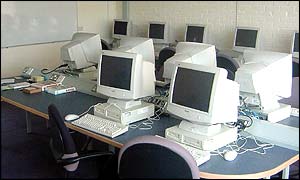 Many schools cluster computers in ICT "suites"
The extent to which schools in England say they are making "substantial" use of computers - and see any benefit in using them - has fallen dramatically in the past year. This is despite the fact that spending has gone up significantly. The government says the usage figures are distorted by a change in the wording of its annual survey, and that the important thing is how schools use computers, not how much. A separate report by its computer agency shows a benefit in terms of pupils' achievement in schools which are making extensive use of information and communication technology (ICT). Teachers' confidence In the Department for Education's survey, responses were received from a nationally representative sample of 840 primary schools, 790 secondary and 360 special schools: about 70% of those surveyed responded. In primary schools, average spending on ICT rose by half in the space of a year from �10,300 to �15,400. In a typical secondary school the spending rose from �60,300 to �76,900. The proportion of secondary school teachers trained to use ICT was 73%, and the proportion who felt confident to use ICT in the curriculum was 75%. In primary schools, 93% had been trained - up from 80% the year before - but there was no increase in their confidence level: the figure was static on 76%. Usage And in their actual use of ICT in various curriculum areas there were dramatic changes. In 2001, primary schools reported making "substantial" use of ICT to differing extents depending on the subject, from 89% in English to just 1% in modern foreign languages and PE. But in 2002, the "substantial" use had dropped across the board. In English it had fallen to 65%. In maths it had gone from 74% to 48%, in science from 50% to 26% and in history from 46% to just 9%. The pattern was repeated in secondary schools. Maths: 60% down to 21%. Science: 67% to 29%. Design and technology: 81% to 56%. There was a similar pattern in special schools. Not surprisingly, the figures for the perceived benefit of using ICT in those subjects showed the same dramatic falls. In each case the only area where "substantial" use and perceived benefit continued was in the subject of information technology itself. Changes The survey was a little different this year. Previously, schools had been asked to say, for each subject, whether their use, and the perceived benefit, was either "substantial" or "little/none".
A spokesperson said what the survey really indicated was a changing pattern of use. "What the survey doesn't tell us is what was being used - is it hardware? software? interactive whiteboards? The survey doesn't go into that level of detail," she said. Also what mattered was not the volume of use but how ICT was used. "And that comes down to the skills of the teacher in the classroom - simply having ICT in the classroom doesn't necessarily have an effect, it's what the teacher and pupils do with it that counts." Impact The government's computer agency, Becta, said a quick analysis of Ofsted reports across the two years showed the usage in core subjects was about the same, so it did appear the survey findings were down to the nature of the questions. The agency has just published a report called ImpaCT2, based on a detailed study between 1999 and 2002 of 60 schools in England. This found no "consistent" relationship between the average amount of ICT use in any subject and its apparent effectiveness in raising standards. But 12 out of 13 schools that were high users of ICT outperformed schools which used ICT relatively little. Key findings:
"This is likely to rise as teachers gain in knowledge and experience, as equipment is made available in more classrooms and as there are improvements in the variety of software available, both on the internet and on CD-ROM," it said. The findings also show that often pupils were using computers at home as much as at school. Peter Avis, the agency's quality co-ordinator, said: "All the evidence is that although it is not as much as we want, there is a continued increase in use of ICT within subjects. "But there is an awful long way to go to get full integration. "It's patchy. Some schools are doing really well, others are not." | | See also:  28 Oct 02 | Education 10 Apr 02 | Education 09 Jan 02 | Education 08 May 01 | Education Internet links: The BBC is not responsible for the content of external internet sites Top Education stories now: Links to more Education stories are at the foot of the page. | |||||||||||||||||||||||||||||||||||||||||||||||||||||||||||||||||||||||||||||||||||||||||||||||
| |
|  E-mail this story to a friend E-mail this story to a friend |
| |
| Links to more Education stories |
| | | ||
 | ||||
 | | Back to top
| ||
| ---------------------------------------------------------------------------------- To BBC Sport>> | To BBC Weather>> | To BBC World Service>> ---------------------------------------------------------------------------------- © MMIII | News Sources | Privacy |






