|
 |
 | | | | | | ||||||||||||||||||||||||||||||||||||||||||||||||||||||||||||||||||||||||||||||||||||||||||||||||||||
| | | You are in: UK | ||||||||||||||||||||||||||||||||||||||||||||||||||||||||||||||||||||||||||||||||||||||||||||||||||||||
|
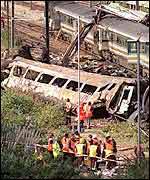
| | Tuesday, 23 July, 2002, 11:35 GMT 12:35 UK HSE faces Paddington claim  Thirty-one people died in the head-on crash The Health and Safety Executive (HSE) has failed in a legal attempt to halt a multi-million pound damages claim it faces over the Paddington rail crash. Mr Justice Morland refused to throw out the case - brought by Thames Trains - at a preliminary stage. The HSE had argued there were no reasonable grounds for bringing it or that it would be an abuse of process. The rail company claims the HSE failed in its duty to ensure the region's infrastructure was secure, before the accident which claimed 31 lives in October 1999.
The HSE had claimed "blanket immunity" from any personal injury claims arising from any failure in carrying out its statutory functions. And at a hearing last month, Hugh Carlisle QC told the judge it had been "clear from the beginning" that no duty of care was owed by the HSE. But Lord Brennan QC, for Thames Trains Ltd, says the HSE failed in its duty to ensure the safety of the rail network, on behalf of the transport minister. Thames Trains has already paid out �12m to survivors and those bereaved by the October 1999 crash. 'Catastrophic accident' Mr Morland, sitting in London, said because of the HSE's Railway Inspectorate's "alleged close involvement in and knowledge of the dangerous situation at Ladbroke Grove junction with inaction over a period of three years", the victims may have had a realistic chance of successfully suing the HSE. But he conceded the "catastrophic accident" had probably been due to the Thames train driver not having kept a look-out on and a failure by Railtrack, which had controlled the infrastructure was responsible for the signalling system at the junction. The HSE "has neither the staff, nor the resources nor the funding" to carry out the safety work for which Railtrack and train operators were responsible, the judge said. Red light He said the HSE's role was not to run the railways, but it was responsible for safety from personal injury. And he concluded: "It could be reasonably argued that the executive should be made liable not for failing to use statutory powers involving expenditure of money but for failing negligently to use, as the public would expect, their statutory powers through the Railway Inspectorate in carrying out routine duties of inspection and supervision." Thirty-one people died and 500 were injured in the accident in which a Thames train went through a red light and crashed almost head-on with a London-bound Great Western express at Ladbroke Grove, just outside Paddington in west London. | |
See also:  13 Mar 02 | UK 19 Jun 01 | UK 04 Jul 01 | UK 01 Oct 00 | UK Internet links: The BBC is not responsible for the content of external internet sites Top UK stories now: Links to more UK stories are at the foot of the page. | ||||||||||||||||||||||||||||||||||||||||||||||||||||||||||||||||||||||||||||||||||||||||||||||||||||
| |
|  E-mail this story to a friend E-mail this story to a friend |
| |
| Links to more UK stories |
| | | ||
 | ||||
 | | Back to top
| ||
| ---------------------------------------------------------------------------------- To BBC Sport>> | To BBC Weather>> | To BBC World Service>> ---------------------------------------------------------------------------------- © MMIII | News Sources | Privacy |