|
 |
 | | | | | | |||||||||||||||||||||||||||||||||||||||||||||||||||||||||||||||||||||||||||||||||||||||||||||||||||||||||||||||||||||||||||||||||||||||||||||||||||||||||||||||||||||||
| | | You are in: Science/Nature | |||||||||||||||||||||||||||||||||||||||||||||||||||||||||||||||||||||||||||||||||||||||||||||||||||||||||||||||||||||||||||||||||||||||||||||||||||||||||||||||||||||||||
|
| | Wednesday, 18 December, 2002, 14:49 GMT Black hole hunter's first image  The GRB was seen on 25 November The Integral gamma-ray observatory - described as Europe's "black hole hunter" - has produced its first images of the Universe.
One of the first pictures, released at a press conference in Paris on Tuesday, shows a so-called gamma-ray burst (GRB). The stream of high-energy radiation, which lasted just 20 seconds, came from an immensely violent event located about 5,000 million light-years from Earth. GRBs are mysterious events that occur infrequently to our observation but when they do, they shine as brightly as hundreds of galaxies each containing millions upon millions of stars. Ready soon Astronomers speculate such events could result from the explosions of giant stars, or perhaps the collisions of extremely dense neutron stars to form black holes.
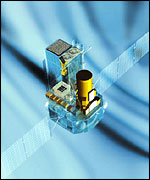
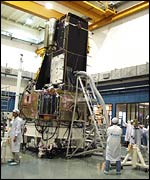
Integral (short for INTErnational Gamma Ray Astrophysics Laboratory) can capture gamma rays, X-rays and visible light simultaneously. It was built by the European Space Agency and launched on the Russian Proton rocket from Baikonur in October. There is huge demand for its services and Esa says astronomers should start to get observing time within the next few weeks. Ripped apart "We have been optimising the instruments' performance to produce the best overall science. We expect to be ready for astronomers around the world to use Integral by the end of the year," says Arvind Parmar, acting Integral Project Scientist at Esa.
Integral has been called Europe's "black hole hunter" because it will scan along the galactic plane each week looking for new sources of gamma rays, which could well be new black holes. It will also study those already known in far more detail than previously possible. Integral will allow insights into the behaviour of black holes and register the gamma radiation emitted by fast-moving particles accelerated in the region around the holes by their huge gravitational pull. Supermassive holes As a first test, Integral observed the Cygnus region of the sky, looking particularly at an object known as Cygnus X-1. This object has long been known to be a constant generator of high-energy radiation. Most scientists believe that Cygnus X-1 is the site of a black hole, containing around five times the mass of our Sun and devouring a nearby star. Observing objects like Cygnus X-1, which is relatively close by in our own galaxy - only 10,000 light-years away - will help scientists better understand so-called stellar- sized black holes. The observatory should also provide fresh insight into supermassive black holes, such as the one though to exist at the centre of the Milky Way. This black hole is calculated to have almost three million times the mass of our Sun Integral sits in an orbit between 9,000 and 153,000 kilometres above the Earth. | |
See also:  17 Oct 02 | Science/Nature 28 Mar 02 | Science/Nature 30 Nov 99 | Science/Nature Internet links: The BBC is not responsible for the content of external internet sites Top Science/Nature stories now: Links to more Science/Nature stories are at the foot of the page. | |||||||||||||||||||||||||||||||||||||||||||||||||||||||||||||||||||||||||||||||||||||||||||||||||||||||||||||||||||||||||||||||||||||||||||||||||||||||||||||||||||||||
 | |
|  E-mail this story to a friend E-mail this story to a friend |
| |
| Links to more Science/Nature stories |
| | | ||
 | ||||
 | | Back to top
| ||
| ---------------------------------------------------------------------------------- To BBC Sport>> | To BBC Weather>> | To BBC World Service>> ---------------------------------------------------------------------------------- © MMIII | News Sources | Privacy |




 These [first] images and spectra prove that Integral can certainly do the job it was designed to do, and more