|
 |
 | | | | | | |||||||||||||||||||||||||||||||||||||||||||||||||||||||||||||||||||||||||||||||||||||||||||||||||||||||||||||||||||||||||||||||||||||||||||||||||||||||||||||||||||||||||||||||||
| | | You are in: Science/Nature | |||||||||||||||||||||||||||||||||||||||||||||||||||||||||||||||||||||||||||||||||||||||||||||||||||||||||||||||||||||||||||||||||||||||||||||||||||||||||||||||||||||||||||||||||||
|
| | Thursday, 17 October, 2002, 09:48 GMT 10:48 UK 'Black hole hunter' telescope launched 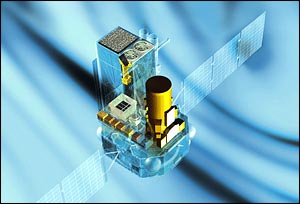 It simultaneously captures gamma rays, X-rays, and visible light
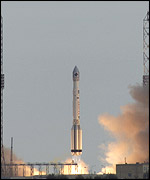
The Integral gamma-ray observatory - described as Europe's "black hole hunter" - lifted clear of the Baikonur cosmodrome at 0441 GMT.
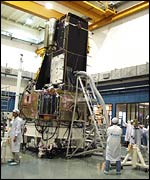
The satellite opened its solar batteries and came in contact with its German control centre at 0831 GMT. It will be some weeks before Integral is fully operational. Quick response Gamma rays are very high-energy light. The four instruments on board Integral (short for INTErnational Gamma Ray Astrophysics Laboratory) are designed to capture the gamma rays, X-rays and visible light simultaneously. Of particular interest will be the mysterious gamma-ray bursts, which flash across the sky above our heads at the rate of about one a day, but can disappear within a few seconds. No-one can predict where the next will come from.
Another of Integral's key tasks will be to study the formation of the elements. Hydrogen and helium were created in the Big Bang, but the other, heavier atoms were created inside stars. Arvind Parmar, acting project scientist for the mission, told BBC News Online: "If you take a glass of water, the hydrogen in it was created inside the Big Bang billions of years ago, but the oxygen in the water was created in a star. "How that oxygen was made in the star and got into space and then into the glass of water is one of the key questions that Integral's going to be addressing." The observatory was designed and built by the European Space Agency, but it was launched on the Russian Proton rocket from Baikonur in return for observing time for Russian astronomers. They will be allocated almost 30% of the "open" time on Integral. Fingers crossed There is huge demand for its services - it was oversubscribed 20-fold in its first year. Professor Giorgio Palumbo of the University of Bologna, Italy, mission scientist on Integral, is confident Integral will perform well.
"That would really be the reward of a lifetime. They're very rare and we might not get one. But Integral is built for that, so I'm keeping my fingers crossed. "If one could explode for Integral that would be fantastic. We'd learn about exploding stars, the formation of black holes or pulsars, about nuclear synthesis - it's 90% of astrophysics in one blow. It's a little Big Bang and very important." Testing theories Integral has been called Europe's "black hole hunter" because it will scan along the galactic plane each week looking for new sources of gamma rays, which could well be new black holes. It will also study those already known in far more detail than previously possible. John Credland, head of space science projects at the European Space Agency (Esa), says there could be new insights into relativity. "Is it absolutely correct or are there deviations from it in the vicinity of black holes where there are very strong gravitational fields, which don't occur anywhere else in the Universe? "All this kind of stuff is open to speculation still and even within the Integral team many of the scientists have disparate views on this." Man's curiosity Integral will allow insights into the behaviour of black holes and register the gamma radiation emitted by fast-moving particles accelerated in the region around the black hole by their huge gravitational pull. The experiments on board the spacecraft cost a total of around �100m and the spacecraft itself cost three times that amount. There are no obvious spin-offs from the research, but John Credland says it is well worth it. "Mankind has a thirst for knowledge. Why are we going to do this? Because we haven't done it before and we want to understand more. That's just the curiosity of mankind." The spacecraft will be controlled from the European Space Operations Centre (Esoc) in Darmstadt, Germany, for the duration of its lifetime, expected to be two years minimum. Space doctors Communications are via ground stations in Belgium and America. Jocelyn Landeau-Constantin, of Esoc, says: "We have to make sure the spacecraft is following exactly the right path and there will be a lot of manoeuvres to stabilise the satellite. "We'll also be controlling its temperature - that's extremely important for the electronics, for the spectrometer and the imager, so that there's no interference with the scientific data. "Basically the specialists here are space doctors who take care of the satellite, making sure it's switched on, moving in the right direction, that all the instruments are functioning and providing good data." It will be several months before it is known whether all the instruments on board are working perfectly. | |
See also:  28 Mar 02 | Science/Nature 01 Mar 02 | Science/Nature 09 Aug 00 | Science/Nature 10 Dec 99 | Science/Nature 30 Nov 99 | Science/Nature Internet links: The BBC is not responsible for the content of external internet sites Top Science/Nature stories now: Links to more Science/Nature stories are at the foot of the page. | |||||||||||||||||||||||||||||||||||||||||||||||||||||||||||||||||||||||||||||||||||||||||||||||||||||||||||||||||||||||||||||||||||||||||||||||||||||||||||||||||||||||||||||||||
| |
|  E-mail this story to a friend E-mail this story to a friend |
| |
| Links to more Science/Nature stories |
| | | ||
 | ||||
 | | Back to top
| ||
| ---------------------------------------------------------------------------------- To BBC Sport>> | To BBC Weather>> | To BBC World Service>> ---------------------------------------------------------------------------------- © MMIII | News Sources | Privacy |