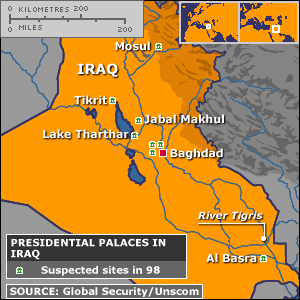
If they make an exception for presidential sites, it would undermine their own charges that Iraq uses these places to hide forbidden weapons. Significant
The recently published British dossier on Iraq claimed: "Many of these so-called palaces are in fact large compounds which are an integral part of Iraqi counter-measures designed to hide weapons material."
So they are still regarded as potentially significant.
Click here to see map of key sites
The presidential sites - eight in number - were the subject of a special agreement between the UN and Iraq in early 1998.
The UN Secretary General Kofi Annan flew to Baghdad himself to meet Saddam Hussein. He did so because Iraq had suddenly refused access to the sites even though they were not given any special protection in the original UN resolutions.
It was agreed that a special procedure should apply to them.
- Any inspections of such sites had to be ordered by the heads of the inspection commission (at the time it was Unscom) and the International Atomic Energy Agency (IAEA). That meant that inspections could not be left to the teams on the ground in Iraq.
- The inspectors had to be specially chosen for specific tasks by the heads of the two agencies. That was supposed to allay Iraqi fears that spies would be among the inspectors.
- The Iraqis had to be notified of the date of inspection in advance.
- A special group of senior diplomats would be chosen by the UN to observe the inspections.
That was agreed on 23 February 1998.
Nothing found
An inspection was ordered for 25 March and a subsequent UN report noted that "Iraq had over a month to make whatever preparations it desired."
A team of just over 70 inspectors from 11 countries assembled in Bahrain and flew into Iraq.
From 25 March to 4 April, they visited all eight sites and inspected 1,000 buildings.
Their report said that the main purpose of the visits was to draw up a database and to gain a better understanding of the sites.
The inspection, the report said, "was not intended to be a search for prohibited material and none was found".
In fact, there was little equipment or documentation anywhere.
"It is clearly apparent that all sites had undergone extensive evacuation," the report said.
"The buildings were largely empty."
Iraq said that they had cleared the sites in anticipation of air strikes.
Later that year, the inspection teams ran into other problems with the Iraqis and were pulled out.
They have not been back.




 E-mail this story to a friend