|
 |
 | | | | | | ||||||||||||||||||||||||||||||||||||||||||||||||||||||||||||||||||||||||||||||||||||||||||||||||||||||||||||||||||||||||||||||||||||||||||
| | | You are in: Business | ||||||||||||||||||||||||||||||||||||||||||||||||||||||||||||||||||||||||||||||||||||||||||||||||||||||||||||||||||||||||||||||||||||||||||||
|
| | Tuesday, 19 November, 2002, 12:23 GMT US backs Pakistan on terror funds 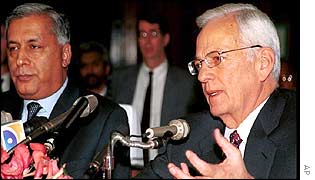 Pakistan's support for the US has helped its economy Pakistan has won praise from the US for its efforts against the funding of terror - efforts which should win it further financial help from the world's biggest economy. The praise came from US Treasury Secretary Paul O'Neill, who is now in the capital Islamabad as part of a five-day tour of South Asia. "There is a major effort under way and continuing in Pakistan to go after tainted money," Mr O'Neill told reporters after talks with Finance Minister Shaukat Aziz and his officials. "This is a home-grown effort in collaboration with nations around the world who are all dedicated to dealing with this issue of tainted money." Pakistan has put in place a number of measures to bring its banks in line with international standards for fighting money laundering. Back in favour Officially, of course, there is no connection between the international community's willingness to give aid to Pakistan and the country's allegiance to the US-led "War on Terror". "I don't think these are connected subjects," Mr O'Neill told reporters. Certainly the economy has improved, and observers say that the government is staying much more closely than before to the conditions laid down by the International Monetary Fund. But in economic terms Pakistan has done well out of the decision last year by its president, General Pervez Musharraf, to turn against the then Taliban government in Afghanistan. The decision reopened the flow of international finance, which was cut off after the military coup in 1999 and the long delay in holding free elections. Less than 24 hours after Mr O'Neill's arrival the latest tranche of a $1.4bn loan from the International Monetary Fund - the fourth, worth $151m - arrived at Pakistan's central bank. Foreign reserves are now up to a record $8.68bn, a spokesman told Agence France-Presse, while economic growth in the year to June was 3.6%. And the US alone has contributed $900m in aid, as well as rescheduling $3bn of debt. Another aid package worth $1bn is under consideration in Congress. Difficulties But there remain questions whether the government's efforts against terrorist finance are successful. Unofficial financial flows - known as "hawala" or "hundi" - between Pakistan, Afghanistan, the Middle East and the West are still intact and largely unregulated. Most investigators believe that the funding flows used by organisations such as al-Qaeda have now switched largely to precious stones and other easily portable items of value. The borders remain porous, thanks to the sheer length of the frontier and the difficult terrain, making the transfer of such items easier. | | See also:  12 Nov 02 | Business 07 Nov 02 | Business 03 Sep 02 | Business 04 Sep 02 | Business 23 Aug 02 | Business 05 Jul 02 | Business 18 Mar 02 | Business Internet links: The BBC is not responsible for the content of external internet sites Top Business stories now: Links to more Business stories are at the foot of the page. | ||||||||||||||||||||||||||||||||||||||||||||||||||||||||||||||||||||||||||||||||||||||||||||||||||||||||||||||||||||||||||||||||||||||||||
| |
|  E-mail this story to a friend E-mail this story to a friend |
| |
| Links to more Business stories |
| | | ||
 | ||||
 | | Back to top
| ||
| ---------------------------------------------------------------------------------- To BBC Sport>> | To BBC Weather>> | To BBC World Service>> ---------------------------------------------------------------------------------- © MMIII | News Sources | Privacy |