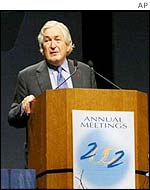
|
 |
 | | | | | | |||||||||||||||||||||||||||||||||||||||||||||||||||||||||||||||||||||||||||||||||||||||||||||||||||||||||||||||||||||||||||||||||||||||||||||||||||||||||||||
| | | You are in: Business | |||||||||||||||||||||||||||||||||||||||||||||||||||||||||||||||||||||||||||||||||||||||||||||||||||||||||||||||||||||||||||||||||||||||||||||||||||||||||||||||
|
| | Monday, 30 September, 2002, 00:21 GMT 01:21 UK IMF tackles private sector 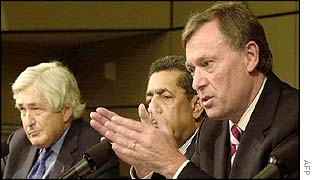 Horst Koehler (r) said there were signs of recovery
Delegates to the annual meetings of the World Bank and International Monetary Fund (IMF) have concluded their meetings in Washington with a plea to the private sector to work together to solve future debt crises.
The abbreviated meetings were held under tight security with threats of violent demonstrations by anti-globalisation protesters. "The fact that 184 members of the Fund and the Bank come together in this quite uncertain world is important in its own right," said IMF managing director Horst Koehler. He sought to reassure delegates that the reforms undertaken by the IMF during his two-year tenure continue with more on the way. World bankruptcy court The reforms come in response to harsh criticism that IMF policies have been too rigid and have driven some developing countries further into poverty under a pile of debt. In addressing the failure of such schemes leading policymakers agreed on Saturday to speed efforts to develop a "sovereign bankruptcy" procedure for countries in debt crises. The plan, which the IMF is to debut in April, would in essence set up a international bankruptcy court to deal with countries who default on loans. Such a programme, pushed by IMF deputy managing director Anne Krueger, would allow countries to suspend debt payments amid economic upheaval, such as the one recently witnessed in Argentina. The Krueger proposal remains a hotly debated issue. Members of the business and banking community have warned financiers would be less likely to make loans to countries with risky credit profiles. IMF officials said, however, declaring bankruptcy would be used only as a last resort. Backing Japan The world economy took centre stage during much of this year's meetings.
While many expressed concern over the nascent recovery, others, such as Mr Koehler, said it was important to remain vigilant but there were positive signs. "I was encouraged because there was no doom-and-gloom discussion but a differentiated analysis and some realistic confidence that the recovery will continue," Mr Koehler said. The IMF chief also said following discussion with Japanese officials that he had "a bit more positive assessment" of their proposals for financial reform. Among those is one that would allow the Bank of Japan to buy shares held by banks in order to stabilise the country's financial sector. "Japan - with its decision to buy stocks - contributed to the sense of urgency" for Japanese officials to push through reforms to revive its recession-plagued economy, Mr Koehler said. The plan drew criticism from US Treasury Secretary Paul O'Neill on Saturday, leaving Japanese officials scrambling to defend their scheme. Devilish details Mr Koehler also said the corporate-accounting scandals which have rocked the US stock markets have had a great effect on the Bretton Woods institutions, as the World Bank and IMF are also known. On Saturday, a committee of the IMF welcomed reform proposals put forth by US officials to ensure market confidence.
Mr Koehler said one discussed proposal called for the international harmonisation of accounting rules. He also said he was not surprised by some scepticism over the Krueger plan to establish a international bankruptcy court for countries. Emerging-market countries could see such a proposal as yet another cost of doing business. "The devil lies in the details," he said of the so-called sovereign debt restructuring programme, the proposal for which is expected to be outlined in April at the next meeting of finance ministers. While there was no agreement on such a plan, Mr Koehler said members expressed the need for better mechanisms to restructure unsustainable debt. Listening to critics Mr Koehler's counterpart at the World Bank, James Wolfensohn, urged delegates to get on with their work and to stop philosophising over whether programmes would be successful. "We have been left with a number of things to do," Mr Wolfensohn said in a press conference following the conclusion of the annual meetings. "The notion that we should move forward is accepted by everybody," he said. He said the World Bank remained committed to pushing forward their proposals to attain the United Nations Millennium Goals. Among those is the Education for All initiative, which sets 2015 as a deadline. | |
See also:  29 Sep 02 | Business 29 Sep 02 | Business 28 Sep 02 | Business 28 Sep 02 | Americas 27 Sep 02 | Americas 28 Sep 02 | Business 27 Sep 02 | Americas Internet links: The BBC is not responsible for the content of external internet sites Top Business stories now: Links to more Business stories are at the foot of the page. | |||||||||||||||||||||||||||||||||||||||||||||||||||||||||||||||||||||||||||||||||||||||||||||||||||||||||||||||||||||||||||||||||||||||||||||||||||||||||||||
| |
|  E-mail this story to a friend E-mail this story to a friend |
| |
| Links to more Business stories |
| | | ||
 | ||||
 | | Back to top
| ||
| ---------------------------------------------------------------------------------- To BBC Sport>> | To BBC Weather>> | To BBC World Service>> ---------------------------------------------------------------------------------- © MMIII | News Sources | Privacy |