|
 |
 | | | | | | |||||||||||||||||||||||||||||||||||||||||||||||||||||||||||||||||||||||||||||||||||||||||||||||||||||||||||||||||||||||||||||||||||||||||||||||||||||||||||||||||||||||||||||||||||||||||||||||||||
| | | You are in: Business | |||||||||||||||||||||||||||||||||||||||||||||||||||||||||||||||||||||||||||||||||||||||||||||||||||||||||||||||||||||||||||||||||||||||||||||||||||||||||||||||||||||||||||||||||||||||||||||||||||||
|
| | Wednesday, 31 July, 2002, 15:47 GMT 16:47 UK Uruguay banks shut all week 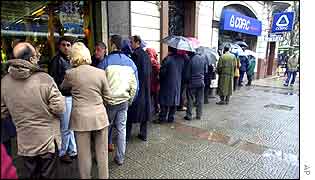 Bank customers fear their accounts will be frozen Uruguay has ordered its banks to stay shut for the rest of the week while it sorts out its escalating financial crisis. However, the government has promised to switch cash machines back on later during Wednesday to allow people to collect their salaries.
The banks were closed on Tuesday as panic about the safety of savings gripped the nation, prompting a rush for cash. A financial storm has been brewing in Uruguay following the meltdown in neighbouring Argentina, a currency flotation and the resignation of the economy minister. 'Sound policies' In a gesture of support, the US has said it is in favour of Uruguay being bailed out of its financial crisis. "Uruguay has been a strong performer in Latin America and deserves the ongoing support of the international financial community for its commitment to sound economic policy," the US Treasury said in a statement.
Local press reports also suggest that the IMF has promised to dish out $1.5bn of emergency aid, as part of a wider $4.7bn package. The country's new economy minister Alejandro Atchugarry said that the IMF had signalled its support for plans to rescue the economy. He also ruled out any chance of an emergency freeze being placed on bank deposits, like the one imposed in Argentina last December. 'Everything's imploding' Withdrawals have already stripped hundreds of millions of dollars from the country's financial system. The Uruguayan currency began to recover after Tuesday's heavy falls, but it has still lost half of its value against the dollar since 18 June. Nervous depositors rushed to cash machines on Tuesday, only to find they had all been switched off while the government was deciding how to save the banking industry from collapse. "That's it, everything's imploding today. The deposit freeze is coming," said one man who lined up to withdraw cash from an ATM machine. The problem has been made worse by mass withdrawals of cash by Argentines from their Uruguayan bank accounts. Reserves plunge Uruguay floated its currency late last month following a run on banks and a plunge in foreign reserves. This was in part due to the knock-on effects of financial problems in Argentina and Brazil. International reserves at Uruguay's Central Bank have fallen 76.6% since January. The country's economy, which has experienced a three-year recession, relies on agriculture, tourism and banking. New economy minister An even deeper recession in Argentina has intensified fears that Uruguay could also face a sustained downturn. Earlier this month, Uruguay's President Jorge Batlle appointed Mr Atchugarry as the country's new economy minister. His predecessor, Alberto Bension, resigned on after losing support for his programme of austerity measures. The economy has shrunk by 10% already this year, as the effects of the Argentine crisis were felt across South America. Have you been affected by the closure of banks in Uruguay? What have been your experiences of the crisis?
Sad, very sad. My family have a farm in Uruguay, which, over the last decades has progressively declined. Farmers and agriculture in Uruguay and Argentina have suffered greatly, and most have large debts. They do not have the luxury of subsidies as most European farmers have, and the produce (mostly organic) cannot compete with the subsidised/industrial scale production of goods produced elsewhere in Western world. Agriculture is the backbone of Argentina and Uruguay. Its collapse is another nail in Uruguay's economic coffin and future. Without much future, I have joined the large young and talented ex-patriate population living overseas. It is true that one of Uruguay's greatest exports is its people, and for such a small country (3.3 million) this represents a huge loss to its future. I remain in hope of returning one day to a brighter future. In addition to loans we need markets and fair trade for our exports. We produce excellent meat and agricultural products but face severe dumping and protection in the EU and US, while we are forced to open our trade to subsidised imports. To show how ridiculous this is, frozen fried potatoes from Belgium are sold in Uruguayan supermarkets at such a low price you couldn't buy potatoes, peel them and pack them locally for that price! It is very difficult to imagine the banks here in London running out of money and closing their doors. But why do we in the West always have to bail out other countries which cannot run their own economy. My girlfriend's family are Uruguayans so I hear about the problems all the time. This crisis is the culmination of a slow decline which has lasted decades. Pensioners, whose life was never lavish by any standards, are now having to fear for their savings and social security. Nobody is spending money any more and shops and businesses are feeling the crunch and laying people off all the time. Most young people are queuing to leave the country as they see no future there. The people with the skills the country needs most are among the first to leave. If no drastic measures are taken quickly, the country will soon plunge into deep catastrophe. The South American crisis is the result of long-lasting political fiesta. I mean a fiesta that has been tolerated by the voters. I hope that a new generation of South American politicians will respect the will of the IMF. When the tent collapses It will not be the centre-post that goes first, but the side-posts and even the stakes. The EEC and the USA must shore up this economy... to keep this "virus" from spreading. The natural forces that affect economies are about to overwhelm the current abstract, theoretical understanding of money. The plutocracy presently in charge of these matters must become alert to the needs of all. | |
See also:  31 Jul 02 | Business 31 Jul 02 | Business 24 Jul 02 | Business 23 Jul 02 | Business 20 Jun 02 | Business 27 Jul 02 | Country profiles Internet links: The BBC is not responsible for the content of external internet sites Top Business stories now: Links to more Business stories are at the foot of the page. | |||||||||||||||||||||||||||||||||||||||||||||||||||||||||||||||||||||||||||||||||||||||||||||||||||||||||||||||||||||||||||||||||||||||||||||||||||||||||||||||||||||||||||||||||||||||||||||||||||
| |
|  E-mail this story to a friend E-mail this story to a friend |
| |
| Links to more Business stories |
| | | ||
 | ||||
 | | Back to top
| ||
| ---------------------------------------------------------------------------------- To BBC Sport>> | To BBC Weather>> | To BBC World Service>> ---------------------------------------------------------------------------------- © MMIII | News Sources | Privacy |