|
 |
 | | | | | | ||||||||||||||||||||||||||||||||||||||||||||||||||||||||||||||||||||||||||||||||||||||||||||||||||||||||||||||||||||||||||||||||||||||||||||||||||||||||||||||||||||||||||||||||||||||
| | | You are in: Americas | ||||||||||||||||||||||||||||||||||||||||||||||||||||||||||||||||||||||||||||||||||||||||||||||||||||||||||||||||||||||||||||||||||||||||||||||||||||||||||||||||||||||||||||||||||||||||
|
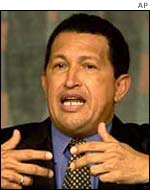
| | Sunday, 23 June, 2002, 16:38 GMT 17:38 UK Venezuelans fear new coup Political tension is again increasing
"Let him go away, however it happens, just as long as nobody dies," said Caracas bartender Luis Aguilar.
The retired military officials wanted to present a petition to the president asking him to respect the traditional merit-based promotion system. During the past weeks, signs of mounting tension have accumulated. On 2 June a group of hooded, uniformed men alleging to be military officers released a video in which they vowed to fight if necessary against Chavez's armed supporters. Meanwhile, the government has been embarrassed by its latest scandal - the disappearance of $3bn from an economic stabilisation fund. Momentum building And the same business-union coalition which led the demonstrations that triggered Chavez's 11 April removal by military officers appears to be rebuilding. The Federation of Chambers of Commerce (Fedecamaras) is threatening a tax boycott, while the principal union, the Confederation of Venezuelan Workers (CTV), is considering calling another nationwide strike. Rowdy marches demanding the president's resignation are taking place weekly.
Parliamentary hearings into the events surrounding the April coup degenerated into mutual accusations and revealed that the government and opposition have diametrically opposite views of what took place. Since April, the sources of discontent which preceded the ouster have, if anything, intensified. The economy, which contracted 4.2% during the first trimester, continues slumping, and foreign investment continues fleeing. Some estimates put unemployment as high as 24%. And so far this year the national currency, the bolivar, has lost a fifth of its value in relation to the dollar. "Everything's shut down, on strike, unemployed, industries are shutting down every day," complained Rafael Zamora, a telephone company manager. Bolivarian circles Despite reshuffling his cabinet and offering to rewrite a series of laws passed last year, the left-wing Chavez has not succeeded in allaying opponents' fears that he intends to transform Venezuela into another Cuba. Mr Chavez has not relented in his backing for his Bolivarian Circles, which he says are social self-help organisations, but which opponents call armed militias. According to many reports, the government has distributed arms to the groups.
Mr Chavez's practice of promoting his allies in the military and ignoring the armed forces' traditional merit-based system has also inflamed military sentiment. The government has revealed its concern about the potential for another coup in various ways. The president has moved forward the traditional date for announcing some military promotions from 5 July to 24 June. On this occasion he is expected to promote his supporters in the military at the expense of officers who revealed their disloyalty after 11 April. Rumours rife And the government recently acknowledged that it had installed anti-aircraft batteries near the presidential palace - a move it called routine. The capital is so rife with coup rumours that the government took the trouble of denying it suffocated a coup attempt a few weeks ago. Observers differ over the military's likely action.
"I think there could be social violence - attacks by small groups," he said. "But none strong enough to take over." Berenice Gomez, who covers the military for the newspaper Ultimas Noticias, says the progress of efforts to remove Mr Chavez by referendum or constitutional amendment have removed the impetus from coup backers. "The constitutional route [to removing Mr Chavez] is getting nearer and nearer," she said. Government opponents have launched various schemes to cut short the president's term, which ends in 2006. These include a constitutional amendment, a political trial or a national referendum, which could be held in August 2003. But these routes could be blocked by Chavez-controlled political institutions. Chavez supporters Mr Chavez is said to hold the support of about one third of Venezuelans, primarily the poor, to whom his "revolution" and fiery rhetoric have given new hope, even though their economic condition has generally worsened under his watch. His supporters are passionate and well organised, and demonstrated after 11 April that they will fight for their leader. Aiskel Blanco, an unemployed TV and radio producer and member of a Bolivarian Circle, promised that in case of another coup they will do so again. "[The people] will descend from the hills, emerge from the barrios - the blacks, the marginalised," she said. "All Venezuelans will defend our president." | |
See also:  16 Jun 02 | Americas 12 Jun 02 | Americas 09 Jun 02 | Americas 14 May 02 | Americas 13 May 02 | Archive 07 May 02 | From Our Own Correspondent 15 Apr 02 | Americas 14 Apr 02 | Americas Internet links: The BBC is not responsible for the content of external internet sites Top Americas stories now: Links to more Americas stories are at the foot of the page. | ||||||||||||||||||||||||||||||||||||||||||||||||||||||||||||||||||||||||||||||||||||||||||||||||||||||||||||||||||||||||||||||||||||||||||||||||||||||||||||||||||||||||||||||||||||||
| |
|  E-mail this story to a friend E-mail this story to a friend |
| |
| Links to more Americas stories |
| | | ||
 | ||||
 | | Back to top
| ||
| ---------------------------------------------------------------------------------- To BBC Sport>> | To BBC Weather>> | To BBC World Service>> ---------------------------------------------------------------------------------- © MMIII | News Sources | Privacy |