|
 |
 | | | | | | |||||||||||||||||||||||||||||||||||||||||||||||||||||||||||||||||||||||||||||||||||||||||||||||||||||||||||||||||||||||||||||||||||||||||||||||||||||||||||||||||||||||||||
| | | You are in: Africa | |||||||||||||||||||||||||||||||||||||||||||||||||||||||||||||||||||||||||||||||||||||||||||||||||||||||||||||||||||||||||||||||||||||||||||||||||||||||||||||||||||||||||||||
|
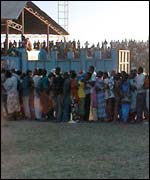
| | Wednesday, 26 June, 2002, 10:28 GMT 11:28 UK Tanzanian train survivor's ordeal Relatives file past bodies to identify their close ones
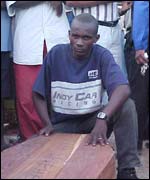
 He is waiting for transport to return his brother's body to their hometown of Kilosa, in eastern-central Tanzania.
He had left his home in Kilosa for the town of Kigwe. "We were travelling fine then suddenly the train stopped and started to move backwards. We jumped off then it seemed to slow so we jumped back on," he says. "At this point the train gathered speed and went rolling fast down the hill. My brother and I became separated." Nightmare scenario "When the train hit the other one, and carriages started to overturn, I got hurt on my leg but succeeded in extracting myself," he continues. "I started to look for Juma, I spent five hours looking for him, my friends helped. Eventually someone said they had seen him."
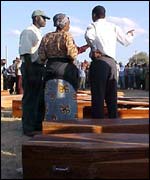
"When I arrived at the carriage there were three on top of each other, I squeezed into a little gap and pulled him out." "He was alive but bleeding all over. I held him in my arms while my friends tried to get help." "I held him for about half an hour, he died in my arms." For Ahmad and other relatives like him, the government of Tanzania has provided coffins for the dead and is arranging transport for the bodies. Dead babies All around us in the Jamhuri Stadium in Dodoma, rows and rows of bodies have been laid out on tarpaulins with their faces uncovered. Relatives walk past in single file looking at the faces in the hope of finding a loved one. In the scorching heat the smell of the bodies is overpowering but the local hospital has treated the dead with formaldehyde to slow the decomposition. The bodies are grouped into male adults, women and children.
Some babies that were found on or near a corpse are grouped together. All around people are huddled in groups, occasionally a heart-wrenching wail pierces the stadium as yet another victim is identified. According to Health Minister Anna Abdallah, the rescue efforts are now concentrated on retrieving dead bodies. Efforts are hampered by the remoteness of the area where the crash occurred. Mobilisation The dead bodies are being driven into Dodoma, about one and a half hour's drive, or being airlifted by a government helicopter. At the site efforts to stabilise the survivors have continued and doctors all over Tanzania have been mobilised. All government officials with a medical background are at the scene. Defence Minister Philemon Sarungi, a trained orthopaedic surgeon, saw 249 patients and operated on 10.
An exhausted Mr Sarungi told me the medical supplies at the site were adequate and the number of doctors arriving from Dar es Salaam had increased. Health Minister Anna Abdallah says the Health Ministry has a fairly adequate supply of drugs and medicines for such disasters. She also commended the locals of Dodoma for their speedy help in donating blood and helping to ferry food to the site for the rescuers. Investigations are currently underway as to how the train, with approximately 1,600 passengers on board, crashed. It is believed the brakes failed, causing the train to stall and roll backwards. It gathered speed and slammed into a cargo train coming behind it. All but one of the 12 carriages rolled and toppled over. The death toll is likely to be much higher as more victims are pulled from the mangled wreck of the train. | | See also:  25 Jun 02 | Africa 25 Jun 02 | Africa 25 Jun 02 | Africa 25 Jun 02 | Africa 24 Jun 02 | Africa 08 Jan 02 | Business 07 Mar 02 | Country profiles Internet links: The BBC is not responsible for the content of external internet sites Top Africa stories now: Links to more Africa stories are at the foot of the page. | |||||||||||||||||||||||||||||||||||||||||||||||||||||||||||||||||||||||||||||||||||||||||||||||||||||||||||||||||||||||||||||||||||||||||||||||||||||||||||||||||||||||||||
| |
|  E-mail this story to a friend E-mail this story to a friend |
| |
| Links to more Africa stories |
| | | ||
 | ||||
 | | Back to top
| ||
| ---------------------------------------------------------------------------------- To BBC Sport>> | To BBC Weather>> | To BBC World Service>> ---------------------------------------------------------------------------------- © MMIII | News Sources | Privacy |