 His time as a teenaged factory worker shaped his work |
The driving force behind one of Britain's most celebrated writers, Charles Dickens, is explained in a document illustrating the hardship he suffered in childhood.
An entry from the Marshalsea Prison day book is to go on display at a National Archives exhibition next week. It marks the day Dickens' father was admitted for massing debts.
Charles Dickens (1812-1870) wrote 25 books, many of which were serialised in magazines and which were characterised by attacks on social evils, injustice, and hypocrisy.
The Victorian is one of 17 great Britons featured in the "Movers and Shakers" exhibition at the National Archives in Kew, west London.
Marie Manning inspired Hortense in Bleak House 
|
His childhood helped to nourish his fertile imagination and his father's imprisonment had a profound effect on him. It meant the young Dickens was forced to leave school at the age of 12 to work in a factory.
The document says John Dickens was "committed for incurring debts to the sum of �40 and 10 shillings".
National Archives curator Sue Laurence says: "That document encompassed the kind of pain, from trying to survive on his own feet, which informed many novels.
"He works through this whole issue in his work - the infantile and feckless adult who is improvident and the child beyond their years having to take on responsibility at a young age."
 | OTHER MOVERS AND SHAKERS |
This painful experience re-surfaces in many episodes of the novels. In Little Dorrit he writes powerfully of the destructive effects of prison on family life. "The shadow of the Marshalsea was a real darkening influence and could be seen on the Dorrit family at any stage of the Sun's course", he wrote.
One theme that recurs is the child being exposed to adversity at an excessively early age, including Oliver Twist, David Copperfield and Nicholas Nickleby.
| MOVERS AND SHAKERS Writer Geoffrey Chaucer 1343-1400 Inventor William Caxton 1415-91 Noblewoman Cecily Neville 1415-95 King HenryVIII 1491-1547 Queen Elizabeth I 1558-1603 Politician and Soldier Oliver Cromwell 1599-1658 Architect Christopher Wren 1632-1723 Astronomer Edmund Halley 1656-1742 Civil Servant Henry Cole 1808-1882 Political Economist Karl Marx 1818-1883 Writer Charles Dickens 1812-1870 Nurse Mary Seacole 1805-1881 Scientist Francis Crick 1916-2004 Mathematician and Computer Scientist Alan Turing 1912-1954 Social Explorer Gertrude Bell 1868 - 1926 Soldier and Statesman Winston Churchill 1874 - 1965 Musician Elton John 1947- |
Dickens briefly resumed school when his father's circumstances improved. He then went on to become a junior law clerk, followed by an independent reporter for the law courts and then a journalist.
A second document that features in the exhibition is a broadsheet written by Robert Huish entitled "the Progress of Crime or the Authentic Memoirs of Marie Manning of Minver Place, Bermondsey".
This popular broadsheet was distributed at the hanging of Marie and Frederick Manning in 1849. Marie was the inspiration for Hortense, the sinister French ladies' maid in Bleak House.
Marie's depiction in the broadsheet matches Dickens' description in the novel where he paints her as dressing neatly with a veil and gloves and having: "a certain feline mouth and general tightness of the face".
Movers and Shakers is at the National Archives in Kew, west London, from 6 December - 31 May.


 One-Minute World News
  News services
 E-mail this to a friend
  Printable version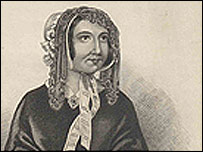
 Enlarge Image


