 Bell analysed the political situation ahead of elections |
In 1921 the new Iraq had hugely important elections which it was hoped would signal a new era. Sound familiar? A key difference back then was a British woman pulling the strings behind the scenes. Explorer Gertrude Bell is often referred to as the "uncrowned queen of Iraq" following her deep involvement with the country during the critical period of its birth. And documents to be featured in a new exhibition show the extent of her influence as the country formerly known as Mesopotamia looked ahead to its first elections. Bell (1868-1926) is one of 17 great Britons featured in the "Movers and Shakers" exhibition at the National Archives in Kew, west London. Letter from British High Commissioner to the Colonial Office, 1927 
|
There are two documents on display. One is a copy of an extract from an Intelligence report written by Bell on 15 April 1921. The other is a letter six years later from the British High Commission in Iraq asking the Colonial Office in London to name a wing of the Baghdad Museum after Bell, at the request of the country's new king, Faisal. In the report, submitted three months before the referendum in July 1921, Ms Bell gives her views on current public opinion, estimating the level of support for the prospective candidates. Her love for travel began early in her life. On leaving Oxford University in 1888, Bell visited Persia (modern day Iran) and fell in love with it.  | OTHER MOVERS AND SHAKERS |
In Switzerland the bold Victorian climbed unexplored icy peaks, in Turkey she visited remote ruins, in Mesopotamia she studied Arabic and she rode side saddle across the Arabian Desert, venturing where few Westerners had dared go She learned Persian and Arabic and how to ride camels, but despite her love of adventure she was politically conservative and joined the Anti Suffrage League. In 1907 she published her first book about Syria and due to her extensive knowledge of the Middle East, Bell became a vital source of information to the British during World War I. Churchill calls As a result, she was the only woman drafted as an intelligence agent and became Oriental Secretary to the High Commission in Basra. Her knowledge of Iraq and Persia continued to be invaluable during the post-war years. | MOVERS AND SHAKERS Writer Geoffrey Chaucer 1343-1400 Inventor William Caxton 1415-91 Noblewoman Cecily Neville 1415-95 King HenryVIII 1491-1547 Queen Elizabeth I 1558-1603 Politician and Soldier Oliver Cromwell 1599-1658 Architect Christopher Wren 1632-1723 Astronomer Edmund Halley 1656-1742 Civil Servant Henry Cole 1808-1882 Political Economist Karl Marx 1818-1883 Writer Charles Dickens 1812-1870 Nurse Mary Seacole 1805-1881 Scientist Francis Crick 1916-2004 Mathematician and Computer Scientist Alan Turing 1912-1954 Social Explorer Gertrude Bell 1868 - 1926 Soldier and Statesman Winston Churchill 1874 - 1965 Musician Elton John 1947- |
When Winston Churchill was made Colonial Secretary in 1921, he summoned his greatest experts on the Middle East to a conference in Egypt to determine the future of Mesopotamia. There were 39 men and Gertrude Bell. In 1921, she was asked to draw up the borders of the new nation of Iraq and helped choose its first ruler, Prince Faisal. For years she was one of Churchill's closest personal and political advisers, a position that earned her the title of "Uncrowned Queen of Iraq". As her political role in Iraq declined with the new regime in power, she returned to her first love - archaeology. In 1923 she became Honorary Director of Antiquities in Iraq and established the Baghdad Museum. At the instigation of King Faisal a wing of the museum was dedicated to her. National Archives senior events and exhibition coordinator Sue Barnard said of Gertrude Bell: "She was one of those Victorian women who did a lot with her life." Movers and Shakers is at the National Archives in Kew, west London, from 6 December - 31 May.
| 

 E-mail this to a friend
  Printable version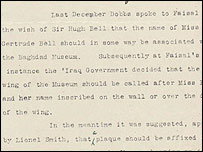
 Enlarge Image


 BBC News


Bookmark with:
What are these?