 Henry changed England's dominant religion |
Henry VIII, notorious for his enjoyment of the high life, hated paperwork and had a stamp made of his own signature to avoid having to sign papers himself. But, as papers which are now being put on show to the public demonstrate, when he cared about something - such as divorce - he would happily take pen to paper.
Henry VIII (1491-1547) is one of 17 great Britons featured in a "Movers and Shakers" exhibition at the National Archives in Kew, London.
Tied to his womanising, the 16th Century monarch became a religious radical when the Pope refused to grant him a divorce from his first wife, Catherine of Aragon. He then founded the Church of England and subsequently dissolved the monasteries.
He ruled England for almost four decades, during which time, the country enjoyed a period of relative stability and prosperity.
The Movers and Shakers exhibition has two major Henry VIII items on display - the first of which is a copy of the French ratification of the Treaty of Amiens from 1527, in which England and France agreed to a perpetual peace. The treaty represented a turning point in diplomatic relations between the two countries - although peace was short lived as Henry went to war with France again in 1544.
 | OTHER MOVERS AND SHAKERS |
The second document gives a neat insight into Henry's personality. It is a draft of the paper to King Francis I of France which explained why Henry was divorcing Catherine and trying to validate his marriage to Anne Boleyn.
Henry loathed the routine business of government and was so reluctant to write that he had a stamp made of his own signature, but he made extensive annotations.
| MOVERS AND SHAKERS Writer Geoffrey Chaucer 1343-1400 Inventor William Caxton 1415-91 Noblewoman Cecily Neville 1415-95 King Henry VIII 1491-1547 Queen Elizabeth I 1533-1603 Politician and Soldier Oliver Cromwell 1599-1658 Architect Christopher Wren 1632-1723 Astronomer Edmund Halley 1656-1742 Civil Servant Henry Cole 1808-1882 Political Economist Karl Marx 1818-1883 Writer Charles Dickens 1812-1870 Nurse Mary Seacole 1805-1881 Scientist Francis Crick 1916-2004 Mathematician and Computer Scientist Alan Turing 1912-1954 Social Explorer Gertrude Bell 1868 - 1926 Soldier and Statesman Winston Churchill 1874 - 1965 Musician Elton John 1947- |
Sue Barnard, National Archives senior events and exhibition co-ordinator, says: "Henry was looking for political support because he proposed a divorce to the Pope. He very rarely wrote anything because he wasn't interested in government business, so the fact he annotated this himself is incredibly significant. "It was obviously a very important matter to him."
Henry had grounds in canon law to secure a divorce, and in previous years the Pope may have granted it. By the start of 1533, however, Pope Clement VII was under the influence of the Holy Roman Emperor Charles V, Catherine's nephew.
If Catherine's marriage to Henry was declared illegitimate, this would jeopardise the claim of her daughter, Princess Mary, to the throne.
Keen to retain political influence in England, Charles saw the value of preserving the legitimacy of his English cousin.
Movers and Shakers is at the National Archives in Kew, west London, from 6 December - 31 May.


 One-Minute World News
  News services
 E-mail this to a friend
  Printable version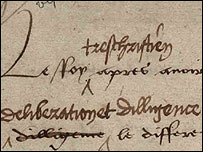

 Enlarge Image


