The species is an extremely voracious predator that outcompetes the UK's native species and even feeds on them.
Peter Brown, from the Centre for Ecology and Hydrology who co-ordinates the Harlequin Ladybird Survey, said: "Our surveys have shown that harlequin ladybirds are spreading extremely quickly and are causing a lot of damage to our native species."
The oak processionary moth (Thaumetopoea processionea), a native species of central and southern Europe, can be found around London.
It is causing ecologists much worry - its caterpillars feed on the foliage of many species of oak, causing considerable damage.
However, it also poses a risk to human health. Silky hairs on the caterpillar contain a toxin, and contact or inhalation can cause severe skin irritation and allergic reactions.
Professor Monique Simmonds, from the Royal Botanic Gardens Kew, said: "This is a real potential pest."
But despite its good looks, this native of central Europe has been causing a problem for gardeners since it invaded the UK in 2003.
It has become a pest on rosemary, lavender and related plants, where it strips the leaves.
Andrew Salisbury, from the Royal Horticultural Society, said the insect was first spotted in the RHS gardens in Wisley, Surrey, but has now spread around the UK.
He is currently monitoring the species' movements. If you have spotted the beetle, you can help by submitting a record of your sighting to the Royal Horticultural Society.
THE HORSE CHESTNUT DESTROYER
Advertisement
Monique Simmonds explains how a tiny moth is damaging the iconic horse chestnut tree
The horse chestnut leaf miner (Cameraria ohridellais) is another recent addition to the UK.
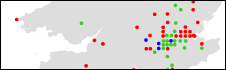
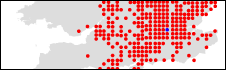
See distribution of horse chestnut leaf miner in England and Wales
After spreading throughout Europe, it was thought to have became established here in 2002.
Larvae of the tiny insect, which belongs to the moth family, burrow into the leaves of horse chestnut trees, creating unsightly brown mines.
Scientists are still unsure whether the moths are damaging the trees, but some believe the insects may leave the trees more susceptible to other pests.
THE LILY DEVOURER
Advertisement
Andrew Salisbury explains how the red lily beetle has spread
The RHS's Andrew Salisbury describes the red lily beetle as "the lily growers' nemesis".
 One-Minute World News


 E-mail this to a friend
  Printable version




 Enlarge Map






 BBC News


Bookmark with:
What are these?