The Delta-4 Heavy can put 13 tonnes into a geostationary transfer orbit 
|
Boeing's new heavy-lift Delta 4 rocket must wait a further week before making its maiden flight from Florida, US. All the technical issues on the 70m-tall (230ft) vehicle that delayed its weekend blast-off have been resolved, but the rocket has now missed its slot.
A Lockheed Martin Atlas 5 has a launch booked on Friday and it will take a few days to prepare Cape Canaveral's tracking and communication systems.
It is possible the Delta 4-Heavy could now lift-off on Tuesday 21 December.
However, this will depend on the Atlas 5 leaving on time and the Cape's systems being reconfigured satisfactorily for the Boeing vehicle.
Sunday's launch was scrubbed to give engineers the opportunity to determine what caused a temperature control system to malfunction after Saturday's aborted.
The Delta 4-Heavy currently has no commercial orders. The maiden flight is a demonstration launch that will lift a 6.5-tonne dummy satellite and two 16kg (35lbs) research nanosats called Ralphie and Sparky.
 Lockheed Martin's Atlas 5 series is a competitor |
The vehicle is capable of pushing 13 tonnes of payload towards a geostationary orbit. Boeing faces stiff competition at home in the form of Lockheed Martin, which is developing a heavy-lift capability on its Atlas rocket series, as well as from international launch service providers, such as Europe's Arianespace.
The latter plans to fly its heavy rocket, the Ariane 5-ECA, from Kourou in French Guiana in January.
It will be a second attempt for the "10-tonne" Ariane; its maiden flight ended in an explosive failure in 2002.
It is possible the heavy-lift Delta and Atlas rockets could form part of the launcher system that succeeds the space shuttle, taking astronauts to the International Space Station and beyond.


 One-Minute World News
  News services

 E-mail this to a friend
  Printable version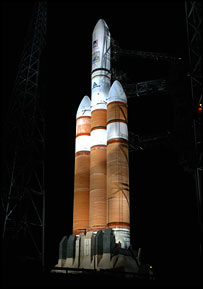
 Enlarge Image