By Irene Mona Klotz
at Cape Canaveral, Florida |

 Boeing is looking for a flawless first flight (Image: C.Bailie/Boeing) |
Although there is little more than dead weight sitting atop the United States' newest heavy-lift rocket, the stakes for the mission could not be greater. Boeing's Delta 4-Heavy is a triple-body rocket which has the punch to haul shuttle-class payloads into orbit.
It is a muscled-up version of the company's Delta Medium line, which debuted two years ago with the launch of a European communications satellite. Since then, Delta rockets have successfully flown two other missions.
Despite the heritage, though, Boeing was unable to secure a payload for the debut flight of Delta 4-Heavy.
The US Air Force, which is depending on the rockets to deliver critical national security payloads, stepped in to pay $141m for a demonstration flight.
The 70m-tall (230ft) rocket's prime payload is a 6.5-ton dummy satellite. Two 16kg (35lbs) nanosat experiments also are flying piggyback.
First-flight jitters
The dummy is called DemoSat. Its only mission is to relay flight and engineering information to ground-control teams. The nanostats, called Ralphie and Sparky, were originally booked on a space shuttle flight.
 |  This business is a very difficult business to be in This business is a very difficult business to be in  |
Even with the US government stepping in for a test flight and signing contracts for two satellite-delivery missions, Delta 4-Heavy has been unable to attract commercial customers. Last year, the company announced it would stop trying.
"With the lack of the commercial market," said Boeing's Delta programme manager Dan Collins, "this business is a very difficult business to be in."
 Europe's Ariane 5-ECA rocket will lift 10 tonnes |
The company faces keen competition from Lockheed Martin, which is developing a heavy-lift version of its Atlas rocket, as well as from international launch service providers, such as Europe's Arianespace and firms offering Russian Proton rockets. Boeing's Delta 4 line had a successful start, but the company was not always so fortunate.
In the 1990s, two satellites were lost aboard Delta 3 rockets. The fact that the boosters which comprise the Delta 4-Heavy have flown before - the rocket is made by strapping together three liquid-hydrogen fueled core boosters to generate more than 2 million pounds of thrust at lift-off - has not eased concerns.
"It's going to be a spectacular launch, certainly, in one of two ways," said Col Mark Owen, commander of the Air Force's 45th Space Wing. "We hope it will be positive."
To the Moon
Arianespace, which botched its debut flight of the heavy-lift Ariane 5-ECA two years ago, certainly can sympathise.
The company announced last month that the booster, which is being marketed as a dual-satellite launcher, will remain grounded until at least January 2005.
Boeing is counting on a successful mission to demonstrate its ability to launch US government spacecraft.
Boeing has produced artwork of one possible look for the CEV 
|
The company already has a contract to fly the military's last Defense Support Program missile detection satellite, slated for launch in late 2005, and a classified spy satellite for the National Reconnaissance Office. The Air Force is expected to request bids for additional heavy-lift launch services, but the number of missions and the timeframe for the flights is unknown.
Another prospect is the US space agency (Nasa). After the shuttle Columbia accident, Nasa was advised to retire the space shuttle by 2010 and develop a new vehicle to carry astronauts to the space station and other destinations, including the Moon and eventually Mars.
Managers decided to return to using capsules launched on expendable boosters, just like the early days of the space programme.
Saving face
Nasa is now considering heavy-lift Delta and Atlas rockets, as well as shuttle-derived booster concepts, for its proposed Crew Exploration Vehicle (CEV).
A successful flight for the Delta 4-Heavy would also help repair Boeing's professional reputation.
Ethics violations stemming from bid proposals for Air Force business continue to plague the company.
At issue are charges of unethical and possibly illegal access to competitor Lockheed Martin's proprietary data that may have helped Boeing win military contracts.
In response, the Air Force cancelled about $1bn worth of business with Boeing and signed contracts with Lockheed for Atlas launch services instead.
Boeing is eager to put the past behind.
"At this point, there is nothing we're worried about," Collins said.


 One-Minute World News
  News services

 E-mail this to a friend
  Printable version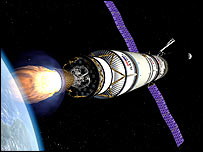
 Enlarge Image