|
 |
 | | | | | | ||||||||||||||||||||||||||||||||||||||||||||||||||||||||||||||||||||||||||||||||||||||||||||||||||||||||||||||||||||||||||||||||||||||||||||||||||||||||||||||||
| | | You are in: Programmes: From Our Own Correspondent | ||||||||||||||||||||||||||||||||||||||||||||||||||||||||||||||||||||||||||||||||||||||||||||||||||||||||||||||||||||||||||||||||||||||||||||||||||||||||||||||||||
|
| | Sunday, 20 October, 2002, 06:17 GMT 07:17 UK Australia's utopian view destroyed 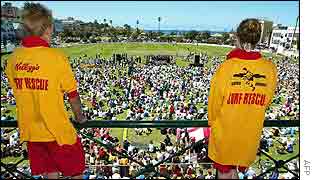 Mourners gathered in Coogee on Sunday
On a Sunday afternoon, the upstairs bar at the Coogee Beach Palace Hotel is a noisy, joyful mass of afternoon drinkers. Crowding onto the balcony, with its views across Coogee Bay, young people, mostly British and Irish backpackers, down beers and soak up the afternoon sun in this Sydney suburb.
There are fewer backpackers and more locals in the downstairs bar. A bank of television screens show the racing and whatever other sport is on. A couple of pool tables are in constant use. This is where, a few weeks ago, you would have found the Coogee Dolphins rugby league team celebrating their end of season. They were about to swap the beach at Coogee for the sands of Bali on a post-season tour and holiday. Overwhelming grief The team is a mix of locals and young lads from country areas far away from the city, like Clint Thompson, the 29-year-old club president.
One of seven children from the small country town of Leeton, he played for the Dolphins with his three brothers. The brothers couldn't make the trip to Bali because of other commitments. But by Monday afternoon, Clint Thompson and five other members of the Coogee Dolphins were dead. The flags above the Beach Palace Hotel were flying at half mast, and it was a very different group of team-mates, friends and family who gathered in the downstairs bar. Their grief was overwhelming. Of the 14 team members who travelled to Bali, only eight made it back alive. Tragic stories Clint Thompson's brothers were inconsolable. They had lost not just their older brother, but many friends as well.
As I walked back to my home, I met a middle-aged woman. Obviously distressed and shocked, she told me her friend's daughter had also died in the blast that tore through the Sari nightclub. It was the daughter's 38th birthday, and she had been out celebrating. I realised later that this was Kathy Salvatori, the wife of the former Rugby League International Craig Salvatori. He had put their two daughters aged six and nine, on a plane back to Sydney so that he could continue to search through the piles of bodies in the Bali morgue. He found the body of his wife three hours later. The couple's story is tragically familiar. Piece of paradise They had travelled to Bali with a big group of friends, some of whom had known each other since childhood. Now several of their number were dead, others severely injured.
The woman I met told me that as soon as she heard about the bomb, she had a feeling she would know someone who had died. Across the country it was the same - mothers, fathers, brothers, sisters; partners and friends, all lost. For years Bali has been the overseas destination of choice for thousands of Australians seeking a quick tropical holiday. And while the rest of Indonesia was sometimes viewed as dangerous and unstable, it seemed as though the island of Bali remained untouched. It was a small piece of paradise with a special link to Australia. But the real world has caught up with this utopian view. And now Australia's troubled relationship with its closest neighbour Indonesia is under review. Lingering resentment It has been a consistent criticism of the Prime Minister John Howard that he has neglected the ties with Indonesia. Certainly his approach is in contrast to that of his Labor predecessor Paul Keating, who believed in active engagement with Australia's South East Asian neighbours, and Indonesia in particular.
Mr Howard has adopted a far more distanced policy. The relationship between the two countries went particularly askew when Australia led the International Force in the formerly Indonesian territory of East Timor in 1999. There is still lingering resentment among some Indonesians over what they see as Australia's betrayal. The tensions between Indonesia and Australia surfaced again when Australia complained about what was perceived as Indonesian inaction over people smugglers. But criticism from Australian ministers only seemed to antagonise their Indonesian counterparts. 'Nowhere is safe' Now the Australians are sounding more conciliatory, offering renewed military contacts and a much closer intelligence sharing operation. Back in Coogee the impact of what has happened is still sinking in. Last year, when press and broadcast commentators gravely intoned that 11 September meant nothing will ever be the same again, it seemed that not many Australians took much notice. They felt Australia was far enough away from the world's hotspots not to have to worry too much. But the events of last weekend have brought violence to the country's doorstep, and the most common thought you hear now is, "Nowhere is safe any more". | |
See also:  18 Oct 02 | Asia-Pacific 16 Oct 02 | Asia-Pacific 17 Oct 02 | Asia-Pacific Internet links: The BBC is not responsible for the content of external internet sites Top From Our Own Correspondent stories now: Links to more From Our Own Correspondent stories are at the foot of the page. | ||||||||||||||||||||||||||||||||||||||||||||||||||||||||||||||||||||||||||||||||||||||||||||||||||||||||||||||||||||||||||||||||||||||||||||||||||||||||||||||||
| |
|  E-mail this story to a friend E-mail this story to a friend |
|  |
| Links to more From Our Own Correspondent stories |
| | | ||
 | ||||
 | | Back to top
| ||
| ---------------------------------------------------------------------------------- To BBC Sport>> | To BBC Weather>> | To BBC World Service>> ---------------------------------------------------------------------------------- © MMIII | News Sources | Privacy |