|
 |
 | | | | | | ||||||||||||||||||||||||||||||||||||||||||||||||||||||||||||||||||||||||||||||||||||||||||||||||||||||||||||||||||||||||||||||||||||||||||||||||||||||||||||||||||||
| | | You are in: Entertainment | ||||||||||||||||||||||||||||||||||||||||||||||||||||||||||||||||||||||||||||||||||||||||||||||||||||||||||||||||||||||||||||||||||||||||||||||||||||||||||||||||||||||
|
| | Monday, 28 October, 2002, 12:24 GMT Asian media's bright future 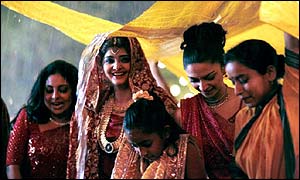 Monsoon Wedding: Asian culture is seeping into the mainstream
The BBC's Asian Network is launching into one of the most vibrant and crowded media markets in Britain. In the past few years there has been an explosive growth in the number of television channels, radio stations, newspapers and magazines aimed at the 1.75 million people from the Asian sub-continent. Much of that growth has been made possible by the digital revolution in television and radio of which the Asian Network is itself a part.
On Sky Digital there are now around 20 Asian channels to choose from, dominated by the "big four" - Zee TV, B4U (the B stands for Bollywood), Sony TV Asia and Star TV - plus spin-offs like Zee Cinema and B4U Music. The four - all with parent channels in India - supply a diet of Bollywood films and music, and programmes made for Indian viewers. Other channels target particular ethnic audiences like Pakistanis, Bangladeshis and Tamils.
TV choice But she says there is a shortage of home-produced programmes, because in this overcrowded market no-one makes enough money from subscriptions or advertising to produce more than a handful of shows in Britain. Despite the intense competition, the quality of programmes has not improved in 15 years. That doesn't bother older, first generation Asian immigrants, she says. "But the second and third generation are more choosy. They demand something better."
There are others in Birmingham, Leicester, Manchester and Bradford, all predominantly music-based. The limited number of stations reflects a shortage of frequencies rather than lack of demand: no fewer than four of the eight groups currently applying for a London-wide AM licence are Asian. They include Asian Talk Radio, a spin-off from Sunrise, and Club Asia, a music station aimed at 15-24 year olds and already broadcasting on Sky Digital. Club Asia is one of the growing number of outlets aimed at younger British Asians. Its managing director, Sumerah Ahmed, says her audience have grown up with radically different attitudes to their parents. That can be a source of tension.
"The second and third generation are very different. It's like taking a 1950s American family and dropping them straight into 2002. They have problems understanding this new way of life." Asian identity Sonia Deol of the BBC Asian Network agrees. She says her own parents' generation worked hard, rarely went on holiday, and saved much of what they earned. Today's youngsters are consumers, happier spending than saving. But she also says that while ten years ago younger Asians tended to adopt Western tastes in music and fashion, today they are more likely to assert their Asian identity in the way they dress and in what they listen to. Anjna Raheja says one manifestation of this is a flood of glossy lifestyle magazines like Asian Woman and Asian Bride, or Indo Brit and Memsahib for younger readers, sustained by the huge Asian fashion industry. But despite all this media activity money is tight for Asian publishers and broadcasters.
And there is a lack of professionalism, especially among advertising sales staff. Mainstream advertisers still fight shy of Asian media. Both Saad Saraf and Anjna Raheja have done their bit to raise awareness. They cite Ford, O2, Dior, BT, Bupa and the Department of Health among mainstream advertisers that have woken up to the significance of the Asian market. But many others still find the market confusing or assume they can reach Asian consumers through mainstream media, which is difficult: Asian viewers watch less terrestrial television than the rest of us, and complain they are underrepresented in programmes and commercials. On the other hand, newspapers for the Asian community - like those for other ethnic minorities - still survive on a kind of indirect government subsidy, in the form of page after page of recruitment advertising from public sector organisations keen to demonstrate their commitment to equal opportunities. Shared experiences Asian readers, listeners and viewers have much in common, especially a shared fascination with the products of the Bollywood entertainment machine, which transcends differences of race and religion. They also have a shared experience of racism - a quarter of Asians surveyed for the Asian Network say they have suffered prejudice or discrimination in the past 12 months. And they share a pronounced interest in marriage - 50 per cent of the Asian Network's listeners go to Asian weddings regularly.
There are differences in affluence: Indians tend to be better off, Bangladeshis tend to be poorer. Though everyone is fascinated by marriage, attitudes to arranged marriages or to the idea of marrying outside one's own community split the generations. Younger people are more likely to enjoy music by British Asian performers than the traditional Bollywood variety. And as the Asian community in Britain changes, so we can expect Britain's Asian media to change with it. | |
See also:  28 Oct 02 | Entertainment Internet links: The BBC is not responsible for the content of external internet sites Top Entertainment stories now: Links to more Entertainment stories are at the foot of the page. | ||||||||||||||||||||||||||||||||||||||||||||||||||||||||||||||||||||||||||||||||||||||||||||||||||||||||||||||||||||||||||||||||||||||||||||||||||||||||||||||||||||
| |
|  E-mail this story to a friend E-mail this story to a friend |
| |
| Links to more Entertainment stories |
| | | ||
 | ||||
 | | Back to top
| ||
| ---------------------------------------------------------------------------------- To BBC Sport>> | To BBC Weather>> | To BBC World Service>> ---------------------------------------------------------------------------------- © MMIII | News Sources | Privacy |