By Joseph Winter
BBC News website, Kinshasa |

As the church bells tolled and the cocks crowed at 0600 (0500 GMT), eager voters in Kinshasa set off while it was still dark to take part in the Democratic Republic of Congo's first multi-party elections in more than 40 years.
 The school turned polling station has gaping holes in the ceiling |
But with such little practice at organising elections, it took officials another hour or so before everything was ready at the polling stations I visited in the capital.
By the time everything was finally in place and voting began, some voters were beginning to get a bit angry, no doubt wondering why they had bothered to get up so early.
Despite the historic nature of these elections, polling stations were not overwhelmed by massive crowds.
Some perhaps anticipated a few teething problems on the part of inexperienced and tired election officials - most of whom had slept the night in the polling stations, either on the floor or on the school benches.
Many Congolese are deeply religious and some wanted to go to church before casting their vote.
New era
Some also harbour doubts about the transparency of these polls - a succession of awful governments has not given people in DR Congo good reason to trust their authorities.
 Many Congolese went to church before going to vote |
One opposition party, the UDPS, which has significant support in Kinshasa, urged its supporters not to go to the polls.
But by mid-morning, there was a steady stream of people going to cast their ballots. Most had high hopes that these elections would take DR Congo into a new era - in which governments ruled for the people, not over them.
When the morning mass finished at 0900 at the Notre Dame Cathedral, many people dressed in their Sunday best clothes - vivid dresses of green, yellow, orange and blue for the women, smart trousers and equally bright shirts for the men - went straight next door to cast their ballots.
Prayers
Voters have a long list of demands from their new government - better schools, hospitals, jobs and lower prices, as well as the end of the conflict which still rumbles on in the east.
In the second city of Lubumbashi, one young woman had a more mundane request: "I want roads - I want to be able to travel to Kinshasa."
 | DR CONGO POLLS 32 presidential candidates 9,709 parliamentary candidates 25.6m voters 50,000 polling stations 260,000 electoral staff |
At present, the only way is to pay about $300 for a one-way flight - way beyond the means of all but a tiny handful of Congolese.
"I am praying for a miracle to save our country," said Therese Mwika, as she came out of the cathedral in Kinshasa.
"When I get sick, there is no medicine. I only get better thanks to God."
Some 60% of Congolese are Roman Catholics and there was some confusion after the head of the Congolese Catholic Bishops Conference, Monseigneur Mosengo, urged the faithful not to vote, because of doubts about security and transparency.
But he changed his mind at the last minute and the priest at Notre Dame urged people to go and vote.
He also told people to choose wisely, not to vote for a friend or relative, but someone who will make things better in Congo.
Mammoth ballot
At the polling station next to the cathedral, people queued up patiently to vote.
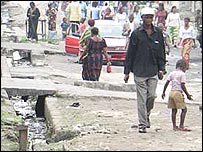
| Open sewers run through this Kinshasa district 
|
They had to be patient because with two ballot papers - one for the presidential contest, another for the new parliament - and a huge choice, it took people up to 10 minutes from start to finish.
One old woman who could not read or write was unable to recognise her favoured parliamentary candidate from the more than 800 small photographs squeezed onto the eight-page ballot paper.
She started shouting outside, asking a relative who she should vote for, before an election official went to her assistance.
Over her head, there were gaping holes in the ceiling, where children normally do their biology lessons, judging by the pictures on the walls.
Just over the road was a reminder of the size of the task waiting for whoever wins the elections.
Foetid open sewers ran down the side of the dirt track in front of the houses in the Lingwala district.
Children played next to the sewers, while women filled up their plastic containers from standpipes and chickens and ducks waddled around, looking for food.
There is no rubbish collection, so instead people set fire to piles of garbage in the road.
In a desperate attempt to make a few extra francs, most houses seemed to double up as commercial enterprises. Beer and mobile phone cards seemed to be the most popular items for sale.
The residents of one such house, relaxing in the shade of a pawpaw tree, said they were desperate to vote. But when I asked what they wanted from the election, none of them mentioned their squalid surroundings.
One woman said education, while two said they wanted to have a single leader who could take decisions, instead of the current, messy set-up in which there is a president and four vice-presidents - a compromise aimed at ending the five-year civil war.
"We want an end to this crisis, we've had enough," said one man in a string vest.


 One-Minute World News
  News services
 E-mail this to a friend
  Printable version

 Enlarge Image
 Do you really think that an election organized with corruption starting from the top to the bottom will be fair?


 Refugees' reactions


