By Steven McKenzie
Highlands and Islands reporter, BBC Scotland news website |
  | Inside the Dounreay Fast Reactor's iconic sphere 
|
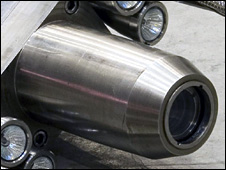
Like a lion tamer putting his head between the gaping jaws of a big cat in a circus act, they have an air of confidence and wary respect. Workers at Dounreay walk around what were the nuclear site's most active areas with familiarity. But cautious of potential radioactive contamination, precautions are taken whenever entering and leaving the reactor sites. Overalls, hard hats, protective glasses and footwear must be donned. To go inside the famous sphere, or golf ball, of the Dounreay Fast Reactor (DFR), the change of clothes is made at an area called the barrier. Leaving involves a routine of stepping into radioactivity detection booths, hand washing and removing protective clothing. A metal plaque on the way through to the 41m (134ft) diameter structure looks out of place amid the high technology being used in the clean-up of the site. But the acknowledgement of The Motherwell Bridge & Engineering Company is a reminder of the site's roots in the rush to harness nuclear power in the 1950s. Another relic of 50 years ago is the massive Goliath crane. One of the first polar cranes in the world, it can rotate within the confines of the sphere. Again, it would look more at home in a Clyde shipyard. The DFR provided the UK testbed to develop fuel technology for the national fast reactor programme. The sphere was constructed as a secondary level of containment in the event that dangerous gases were released in an accident. Operations ceased in 1977 and a gleaming and intricate network of pipes are involved in cleaning the reactor, which is enclosed in a concrete vault. According to staff, a rumble can occasionally be felt from below as a result of the cleaning and decontamination processes. On one edge of the sphere is the former escape route in event of an accident, while on another, a humble cabin has walls covered with complicated schematics of the plant. An adjoining office block houses the DFR control room. It is a blast from the past - a suite of retro dials and knobs in yellow and black. The large rectangular building of the Prototype Fast Reactor (PFR) could be branded boring when compared to the nearby DFR. Inside, however, is a cavernous hall housing its reactor, most of which sits below ground. Removing hundreds of tonnes of sodium which once flowed in its circuits proved to be one of the toughest challenges for the decommissioning project. | The special camera for going inside the Prototype Fast Reactor
|
A 1ft-long pump and 9"-long camera were specially designed and manufactured to suck out the last five tonnes that remained in the bottom of the reactor vessel. It was developed at t3UK, a facility at Janetstown on the outskirts of Thurso. Billy Husband, senior project manager at PFR, spoke proudly of the inventions. He said: "The pump and camera had to go down 18m into the vessel to suck the sodium out. "The sodium was at 200C, but the camera was only good at 60C so we had to cool it down with nitrogen gas. "It took a very complex design to do that and we have applied for a patent for the technology we have basically invented." Mr Husband added: "It was a very complex path to put it down into the reactor because of the innards of the reactor itself. "The major lesson we've probably learned, if we build fast reactors again in this country, is to put a tap at the bottom of the reactor to drain the sodium out because that would have made life so much simpler for us."
|  BBC NEWS CHANNEL


 E-mail this to a friend
  Printable version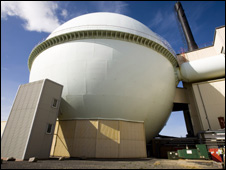
 In pictures
 The major lesson we've probably learned, if we build fast reactors again in this country, is to put a tap at the bottom of the reactor to drain the sodium
 Enlarge Image
 BBC News


Bookmark with:
What are these?