The New Writing North Screenwriting Weekender 2026
Tom Smith reports back from the recent event at Live Theatre in Newcastle and shares writing advice and tips that he picked up from the weekend.
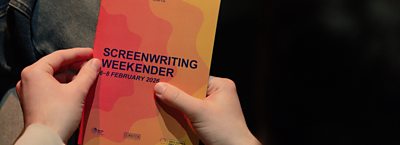

My name is Tom Smith and I’m a working-class scriptwriter from Sunderland. I’ve won a Northern Writers’ Award, storylined at Hollyoaks, completed a Dumping Ground shadow scheme, participated in the BBC Writers Voices programme and developed my original projects with independent production companies.
Sometimes being a writer can feel like you’re in a maze (in the dark, with your shoelaces tied together) so I popped along to the New Writing North Screenwriting Weekender to soak up any useful knowledge to pass on.
On a soggy Friday night in Newcastle, Claire Malcolm, the Chief Executive of New Writing North, welcomed us all to Live Theatre. She spoke about New Writing North’s hopes for the future and the many awards/programmes they offer, which I can’t recommend enough. Winning one changed my life.
The first panel was Original Drama vs IP: Demystifying What’s Being Made and Why
The panel consisted of Siobhan Morgan (Warp Films) and Natasha Heliotis (See Saw Films).
IP is a story that exists in another form, a book for example, that will be turned into a script. When I’m being objective, I understand why production companies like IP, it’s a proven story that works. But when I’m not being objective, why won’t they buy my original ideas? It’s so unfair!
I was pleasantly surprised as Siobhan and Natasha both spoke about their hunger for original drama in an IP saturated world, with the caveat that the scripts must be amazing.
How do you make sure your script is amazing? Love what you write. They said words leap from the page when the writer loves what they’ve written.
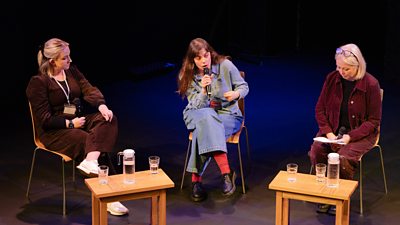
Russell T Davies in conversation.
How do you describe Russell T Davies’ amazing work? The man himself said his work could be split into two categories “either gay or Doctor Who”.
Obviously, this was tongue in cheek, but it set the tone for the fun and engaging talk where he spoke about his journey from Children’s Ward to the heartbreaking It’s a Sin.
Russell also discussed his approach to writing which, as an ardent planner, fascinated me. He is not a planner; not in the traditional sense. His process involves thinking through every aspect of the story before he even puts a single word on the page.
I think every writer eventually settles into their method of working and whatever works for them is the right approach.
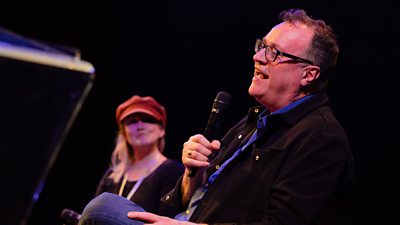
Russell spoke about the importance of finding your voice. He gave credit to his friend for helping him find his voice. After talking about a particularly dark project the friend said, “You’re a laugh, why isn’t it a laugh”.
Another reason why you should always put YOU into YOUR work.
Saturday and Sunday were full of amazing panels and here are the parts I found most helpful.
Kat Rose-Martin was her usual fun and engaging self, when she spoke about The Industrial Ideas Complex.
Prolific Kat spoke about the law of averages in her approach to selling treatments (a document that sums up your idea). The more ideas you have, the more likely you are to flog one!
She discussed her process from idea generation to pitch, but what was most helpful was her checklist for developing an idea.
She always asks herself: Who is the core character? What is the core relationship? What is the beginning/end image? What is the central dramatic question?
Questions like these are so helpful at the start of an idea when the options feel overwhelming.
How to break a show with Sarah Morgan.
Sarah, who has been in over 50 writers’ rooms, spoke about breaking the story down into chunks and threading them together “like a necklace”.
She also talked about the relationship between character and story. To highlight this, she asked for potential stories for a hair salon. People shouted out things like “stuck under hairdryer” and “wrong colouring”. These were all valid stories for that world. But Sarah then asked what stories would there be if Tony Soprano was the stylist? This would change everything.
The lesson: always know your characters before breaking a story. And if Tony Soprano is your hairdresser, you probably should tip him.
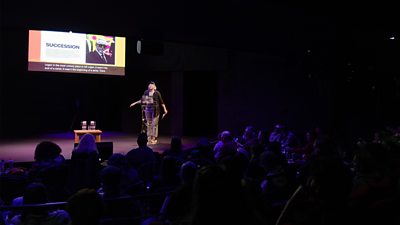
Jeremy Dyson has written some of my favourite characters, so I was looking forward to How to Write Characters We Care About.
Jeremy spoke about how some structures to create characters can be formulaic (even if they were based on something real).
Jeremy’s personal approach makes it very individual to the creator. He says you should build a character on an intense moment of discomfort; observing the feeling that hurt.
One of the examples he used was when he stayed with a distant relative and despite their best efforts it was clear he was not welcome. He had this intense feeling of shame, which he later harnessed and used to create the hilarious characters of the Denton family for the League Of Gentleman. One of my all-time favourite sketches.
This approach is completely new to me, and I can’t wait to try it. I have plenty of moments of discomfort to choose from!
Show me the money! with Lisa Holdsworth, Bridget Deane, Ishy Din and Natasha Salter.
The final panel of the weekend tackled the age-old question, “how much work should you do for free?”
It’s a very tricky subject, but the panel talked about it, back and forth, having all worked for free at some stage in their career. But Bridget summed it up perfectly by saying at a certain point we need money to “pay the mortgage, put food on the table and buy wine on Friday nights”.
They also spoke about the difficulty in making a living as a writer and how important side hustles are, such as talks, mentoring, and blog writing!
And then it was over. I loved my weekend and I can’t wait for the next one.
For those who couldn’t make it the things that jumped out to me were: The industry wants original ideas. Write your spec script and don’t worry about budget. Write with voice and heart. Don’t follow trends.
I’ll leave the last word to this year’s keynote speaker Russell T Davies who said “A good story has been a trend for 5,000 years”.
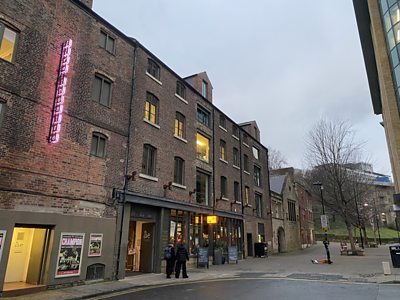

Writing talent is everywhere. But opportunities are not. That’s why New Writing North exists. To identify and nurture talent. To inspire a love for creative writing and reading. New Writing North has been supporting screenwriters with a broad programme of activity since 2014. Their current programme offers awards, mentoring, placements with production companies, writers’ rooms, script hubs, workshops, roadshows and one-to-one surgeries. Their growing network includes those who are totally new to screenwriting; emerging television and film writers; and writers who are experienced in different forms, but are looking to move into screenwriting.
Related Links
- Discover Screenwriting Opportunities from New Writing Northon the New Writing North website
- New Writing North Screenwriting WeekenderFind out more about the event
- Explore writing opportunitieson the BBC Writers website
Latest blog posts
More blog postsSearch by Tag:
- Tagged with BlogBlog
