
Our Drama Room writer development group for 2018 met up recently for their second full day. This time the focus was on Radio Drama. Eno Mfon is part of the group...

“Congratulations on your new job at the BBC! We are all so proud of you, omo dada.”
A text message I received from my aunty in Lagos, Nigeria.
Before I could explain to my mum exactly what the BBC Drama Room is and how I had been selected to be a part of it, the news of my “new job” had already travelled 3121 miles and landed in my aunty’s living room, slightly confused and misunderstood.
I wanted to explain to my aunty that, although, I haven’t been employed by the BBC, I am doing some really exciting work with them. I'm meeting some of the most crucial names in the industry, finding out how they work and how I could one day work with them. I wanted to say “guess what Aunty! I get to write my first spec' script with them. You see, most of my writing career so far has been based in the theatre, but after this scheme I will have a well-polished TV script to show to producers, which is a very big deal. It’s like someone seeing your tinder profile, you know Tinder, right? Well, yeah, it’s like someone looking at your photo and deciding whether they want to swipe left or right and take you on a date (or commission you).”
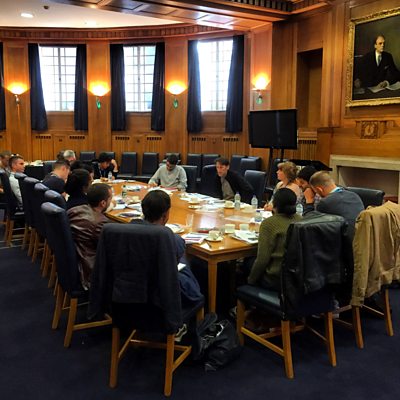
I wanted to tell my aunty all about the sessions we’ve had so far. Our most recent session took us through the ins and outs of Radio Dramas. Literally. We were taken on a tour inside a studio where a radio drama would be recorded. We saw the simulated outdoor site, the kitchen and bedroom, and we discovered the mystery behind recording a realistic sex scene, without the sex (pressing a hole puncher together sounds a lot like a springy bed.)
The day was full of a series of discussions with writers, regional and indie producers, and commissioners from BBC Radio 3 and Radio 4. A discussion with Marc Beeby, a senior producer at BBC Radio Drama, brought up the many ways writing for radio is differently from writing for TV and stage. You have to establish intimacy. Remember that you’re most likely writing for an audience of one; a truck driver on the motorway, a parent washing up after dinner, a student on a long train ride home from university. It’s a one on one conversation and we have the ability to excite a response from the listener using sound, music and language.
My work often uses poetry and music, so it was encouraging to hear that non-naturalistic styles are often effective in radio and we heard evidence of this: ‘Lament’ by debbie tucker green and former BBC Drama Room writer Charlene James’ adapted stage play, ’Cuttin' It’.
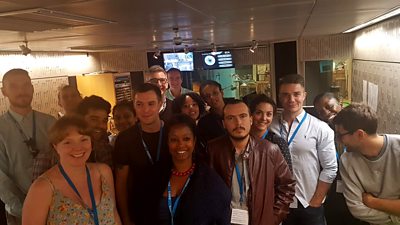
We finished our discussions with a 'speed dating session'. In only a few minutes, we had to introduce ourselves to regional producers, discuss our work and pitch an idea. It was a marathon of a day with a bit of a sprint at the finish line. I left feeling tired, and accomplished…
I wanted to explain all of this to my aunty but instead...
“Thanks aunty! See you all at Christmas!”
Meet the writers in the Drama Room 2018
Find out about Drama Room Day One on a blog post by Patrick Cash
