
1989: CHILDREN OF THE REVOLUTION
Last updated: 3 october, 2009 - 16:48 GMT
Germany breaks borders
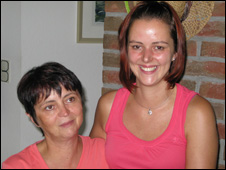
Karin and Katrin
Karin is a 51-year-old teacher who lived, studied and worked in the former German Democratic Republic (GDR), also known as East Germany.
She and her daughter Katrin, a 28 year old social education worker, represent two generations of East Germany.
Today they both live in Bremerhaven which is based in the Federal Republic of Germany, formerly West Germany.
When the Berlin Wall fell on 9 November 1989, the people of the GDR - for the first time in their lives - were free to move to West Germany. Just one year later on 3 October 1990, the country was reunified.
Karin applied for an exit visa to join her husband who had already fled to the West.
The countries had very little in common. Karin was hindered in her normal life in the GDR. She wasn’t able to travel where she wanted to or even take the job she was interested in. Life was safe in GDR, but also boring, tough and some goods were rare and expensive.
That East Germany died with the fall of the Berlin Wall.
This conversation between Karin and Katrin is part of a series of eight cross-generational interviews from Czechoslovakia, Germany, Hungary, Russia, Poland, Romania, Tajikistan and Cuba.
Katrin: So what happened mum, when you applied to leave the GDR? What did the government do to you?
Karin: When I applied for an exit visa I lost my job as a teacher. I couldn’t work anymore and didn’t receive any financial support. It was horrible.
Katrin: So what were your expectations of West Germany, before you left?
Karin: At that time I had no idea what it would be like in the West. My attitude towards West Germany was actually quite negative. If my husband wasn’t living over there, I would never have applied for an exit visa from the GDR on my own.
But I was pleasantly surprised. Everybody really cared about me and were nice to me. The social services department paid me an unemployment compensation. I received an interest-free loan and after six months I got a job.
Katrin: So looking back, was it the right choice for you to leave the GDR?
Karin: Definitely yes. There was no real perspective in the GDR, no possibility of doing something else. Career choices were controlled and you
could not even choose academic subjects on your own. Life was secure, but also really tight.
Katrin: In what way?
Karin: Concerning daily needs. It was quite cheap, but clothes, shoes and cars were really expensive and we lived in a horrible satellite town in Berlin-Marzahn, in a building called Plattenbau, made with precast concrete slabs.
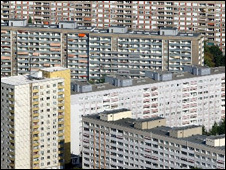
Plattenbau
It was a tight world. We probably would have continued living there, if we hadn't left.
Katrin: From that what I remember, I also think that life was pretty tight.
We never had the opportunity in the GDR, as we did in the West, to go on a school exchange to England or France. Even to Russia, where nobody wanted to go, it was really difficult to go there.
Karin: You had major difficulties joining school in West Germany. You were quite ahead in comparison to your new school mates. So you just laid back then and relaxed. And we really had to push you to finish your secondary school. Education-wise, it would probably be better if you had stayed in the GDR!
Katrin: Yes, I just could not cope with the lax school system. What about our former neighbours or friends? Are you still in contact with them? Have they left East Germany?
Karin: It’s sad; I don’t have any contact with my former colleagues. There were around 20 of us and only two moved to the West. My father still lives in the East and I’m in touch with him but I’ve lost contact with my brothers and sisters.
Katrin: But you seem to be quite happy about how things worked out for you personally after the fall of the Berlin Wall.
Karin: Yes, it all worked out for the best and I definitely don’t want to have the GDR back. For probably about ten years I had dreams during the night that I had to return to the GDR and live there. But luckily that was just a nightmare.



BBC iD
BBC iDBBC navigation
BBC links

BBC © 2014The BBC is not responsible for the content of external sites. Read more.
This page is best viewed in an up-to-date web browser with style sheets (CSS) enabled. While you will be able to view the content of this page in your current browser, you will not be able to get the full visual experience. Please consider upgrading your browser software or enabling style sheets (CSS) if you are able to do so.
