Wednesday 19 September, 2001
New York health fears
Following the attack on the World Trade Centre in New York, on 11th September 2001, workers continue to clean up the debris.
And as if things couldn't get any worse, experts now warn that some people may have been exposed to gases and other substances in the air, which could have long-term effects on their health.
There are also concerns that the safety of the water supply could be compromised. BBC Science reports.
Long-term effects

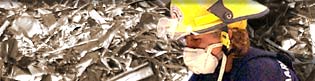
Since the attack and subsequent collapse of the World Trade Centre towers, rescue workers have tirelessly sifted through the debris in the hope to find survivors or human remains.
It is a task that many have claimed to be a living hell, but night and day, and with little thought for their own safety, they have continued to search for the missing.
Whilst federal health officials have provided 10,000 paper filter masks, 5,000 sophisticated masks and 2,000 sets of goggles, they have also reassured that the cloud of smoke that permeates New York does not provide an immediate health threat to the city's people.
However, independent experts remain cautious, claiming that with so many substances present both in the buildings and the planes that crashed into them, it is hard to assess the long-term health effects.
Speaking to the Los Angeles Times, atmospheric chemistry expert Kimberly Prather of UC San Diego, commented:
| 'There is such a mix - jet fuel, the dust from the buildings and the cement, burning electronics, all the wires and the melting pipes - you have to be worried.' |
|
A cocktail of substances
Whilst mobile laboratory machinery, once used in the Gulf War, has already been used to rule out the possibilities that the terrorists also planned a biological attack, the acrid smoke that pervades the city does consist of a cocktail of chemicals.
The fires, which reached a temperature of up to 1,000 degrees Celsius, produced a large number of potentially dangerous substances. Burning aviation fuel gives off several toxic chemicals that can damage lungs and, in the long-term, induce cancers, as do many plastics.
Asbestos
Fears have also been voiced concerning the levels of asbestos that were present in the World Trade Centre buildings.
Asbestos's high melting point meant that it was commonly used to fireproof steel beams in the construction industry. However, when it was discovered that long-term exposure to the material when broken down could cause cancer, the use of asbestos was largely banned.
This ban occurred in the late 1960s and early 1970s in New York; by this time builders on the World Trade Centre had already completed the first 40 floors of the north tower before they switched to a safer material.
Officials have said that dust samples tested at the site have shown low levels of asbestos which in themselves do not pose any health risks. But perhaps the most dangerous substance of all though are particulates - tiny specks of dust produced by all kinds of material when it burns.
Water risks
At present there is no way of knowing how many people have suffered long-term damage; but the greater the exposure, the higher the risk.
Whilst residents and workers in the area have been advised to vacuum their properties with cleaners that contain filters and to wipe surfaces clean, it is the rescuers, rescued and those people who already had lung diseases that doctors will focus their attentions on.
Provisions have been made for those dealing with the devastation on a daily basis.
Rescue workers have been warned of the dangers of HIV infection from blood, environmental agencies are continually monitoring the air quality and although protective wear has been issued to rescue workers, some have chosen not to wear it claiming that the conditions at the scene are too hot and sweaty.
The other potential hazard is the drinking water supply. Groundwater seeping down through the rubble can take bacteria from decaying bodies into damaged, cracked pipes.
Contaminated drinking water is typically responsible for a large proportion of deaths following disasters in the poorest parts of the world, although experts believe that New York's infrastructure is sound enough not to be a problem here.
|  |  | | | Gas fears |  |
| | Amidst the skyscrapers' 1.25 million tons of debris, there are air pockets.
Each time rescue workers enter them in the hope of finding survivors they have been advised to test the air for suffocating gases.
One initial fear was that the fires might have turned a compound called freon from the air-conditioners into a poisonous gas called phosgene.
Experts now believe that any such gases caused by the inferno will have dispersed.
|
|  |
| |