60,000
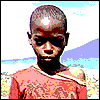
Today in Rwanda, there are at least sixty thousand households run by children. These are families which were left without parents after the genocide five years ago.
Here you can listen to these children reflecting on the genocide and talking about how they are rebuilding and raising their families.
rape
During the war, many girls were raped by the militia and soldiers on all sides. In addition to raising their siblings, these girls are also bringing up the children they conceived when they were raped.
Nyira is one of these girls.
| 

'I was raped by a soldier'
Nyira
(In Swahili)
Read Nyira's story
(In English)
|
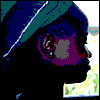
'I could not go to school today as my baby was ill'
Habasa
(In Swahili)
Read Habasa's story
(In English)
| responsibility
Three quarters of all child-headed households are led by girls. There are households where the age of the oldest child is just eleven years old and there may be as many as eight children in a household.
Finding money for food and clothes usually leads the children to beg.Some girls resort to prostitution to raise money. Fetching water, cooking and cleaning are all tasks that are shared amongst the children.
17-year-old Habasa heads a family of five children. She was raped in a camp and is now bringing up her 2-year-old son, 2 sisters and 2 cousins. She finds it hard to combine bringing up a family with going to school. |
'I pray it doesn't happen to others'
Habasa
(in Swahili)
Read Habasa's story
(In English)
| new roles
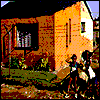
Sometimes the property of these children's parents has been destroyed.
If not it may have been claimed by neighbours and relatives.
The children have to build new houses, or repair damages to existing homes.
Out in the countryside some homes just consist of plastic sheeting.
|
support
Although neighbours and relatives help out when they can, these children still need support in many areas of their lives.
They need help with the provision of food and basic furniture for their homes. They need access to health care and education.
UNICEF is trying to rebuild village life to support these children.
The children also need the emotional support they would have received from parents and older relatives. The Barakabaho Foundation tries to fill this gap. | 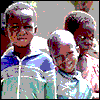
'They have given up their childhood.'
Iget Rutera, UNICEF,
interviewed by BBC Swahili Reporter Valerie Msoka
'They can visit us like we were a grandparent'
Celestine Musesharuwoka, The Barakabaho Foundation |
| | |