|  | For many a house underground conjures up images of Bilbo Baggins’s underground des res at Bag End, the turf topped pad of the Teletubbies or the subterranean headquarters of an evil Bond villain plotting world domination.
In fiction, it seems, you have to be either furry, rich or mad to go underground.
In reality the image of underground living has not faired much better.
Earth-shelter housing, as it is called, is seen as either a rich man’s folly or an underhand way of bypassing the planning laws.
Despite the bad press image, however, earth sheltered housing has taken off across the world.
In China up to 40 million live below ground, in the US numbers reach 100,000 and in Russia it’s reported that there is more development going on underground then above it.
In the UK however it’s a different story.
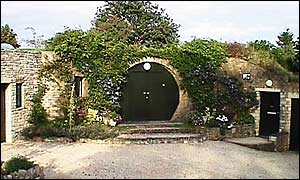 | | 'Mole Manor' underground house, Westonbirt |
The first shelter in Britain
The first British shelter appeared in the late 70s when the architect, Arthur Quarmby, decided to build his family home below the surface of the West Yorkshire moors rather then above it.
The result was definitely no hole in the ground and put paid to the idea that subterranean living was damp, dark and claustrophobic.
Mole Manor, designed as a bachelor pad for a wealthy client, followed. And despite it’s Hobbit like appearance was cited as one of the 12 ‘most desirable pads on the planet’ by the Sunday Times with a £860,000 price tag to prove it.
Despite this the calls to go underground have generally been ignored by Brits and the current tally of shelters across the country stands at a meagre 60. So why aren’t we all taking to the hills? Nettleton's underground House In Nettleton Alvin Howard, a local architect and conservation consultant, is planning just that.
And, if all goes according to plan, his building promises to become one of the area’s only local landmarks you can’t actually see.
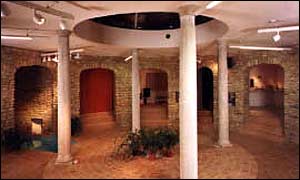 | | The luxurious interior of 'Mole Manor' |
Hunkered into the hillside and covered by a grassy mound the house is designed to be barely visible, above ground, from three of its four sides. Only from the front, where a giant conservatory runs the full length of the façade, will it look like an ordinary house.
Not only does the earth-shelter promise to blend perfectly with the surrounding landscape but it should prove remarkably efficient when it comes to energy use.
Being underground, it seems, has its advantages. Advantages of being underground Not only will the house benefit from the temperature of the ground covering it (10°c in Wiltshire) but the ground also acts as a thermal insulator:
"Being buried it’s taking the ambient temperature from the ground," says Alvin. "So on a day when the temperature is 0°c the temperature inside the house will be 10 to 11°c.
"In time the whole house and the rocks around will become a giant storage radiator. So that each year the temperature of the rocks will go up by a ½ degree or so. After 10 years the temperature will probably be about 60 degrees all year round."
Studies by Bath University on Mole Manor bear this out. Their research team concluded that the underground design used only 25% of the energy of a standard house.
But the savings don’t stop there. Remarkably the south facing conservatory and sky lights are designed to collect heat from the sun which is then passed through heat exchangers to provide hot water and heat for some of the house.
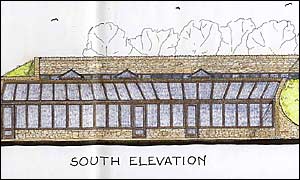 | | The south elevation of Nettleton's underground house |
Solar panels in the glazing, powering batteries the size of small airing cupboards, provide enough electricity to light the house throughout the year. Toss in a link-up to the local electricity board and a long hot summer and the system could even make you some money.
"In the middle of the summer when you’ve got daylight for so long and you’ve got no power being used to heat the house," says Alvin "you’re actually going to have power to spare. You can use your grid connection to sell the power back to the grid."
Even the sewerage system is recyclable. Bath water and washing machine water make a second appearance flushing the house’s toilets. And in its turn the toilet sewerage eventually finds its way back into the cycle having been processed through a system of reed beds.
Drinking water and shower water, however, uses pure rainwater. The water run off from the roof of the conservatory is channelled to a storage tank - large enough to store water for a 3 month drought.
"From day one this house will be sustainable in terms of water supply. Well assuming day one is wet."
With low impact on the landscape, energy efficiency, low maintenance, good insulation and protection from the elements what are the drawbacks of having a roof covered in meadow grass?
The local hunt running across your roof maybe… well you can’t have it all. |




 The modern revival of Earth Sheltered dwelling began in 1973 in the U.S.A.
 View a


 More
More