| Secret underground cities |
| | | | So how does a lifelong fascination with underground bunkers begin?
For Nick McCamley author of Secret Underground Cities it began in the summer of 1967.
Home from college for the weekend Nick met up with an old school friend who told him about a really strange place he had found.
The previous weekend, his friend had been out cycling and stumbled across a large building in the middle of a field in the middle of nowhere.
The building had black pipes radiating out from it in all directions. The pipes spread out across the field before disappearing underground.
He didn’t know what it was but it was really strange.
Nick and a friend decided to check it out
"It was really strange," says Nick "it was like an Avenger’s set."
The building sat at the end of a long concrete road. It had no windows just two huge steel loading bay doors and a small door on the side.
Everything was completely derelict.
"The door was a bit rotten," says Nick "we managed to prize it open and climb in.
"Inside the building was pitch black, so we set light to some bits of paper and wandered around."
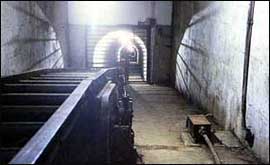 | | Monkton Farleigh - upper terminus of Farleigh Down Tunnel |
Running along the back of the building was a conveyer belt. The belt disappeared through a hole in the end wall covered by a rubber flap.
Curious the boys lifted the rubber flap and climbed through.
Before they knew it they were whistling down a sharp 45° incline:
"We couldn’t stop ourselves," says Nick "We slid off down and finished up about 100 feet underground."
Deep underground and not knowing how they were going to get back out the boys were running out of matches.
Fumbling around in the dark, Nick felt a box on the wall with switches.
"So I turned a few switches and this corridor lit up ahead of us," says Nick.
A corridor that went on for about half a mile.
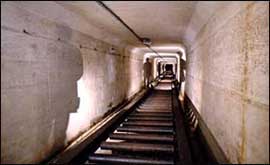 | | A tunnel in Monkton Farleigh |
That was just the start of it.
"All the corridors had rubber conveyer belts," says Nick "we found you could push buttons by the side of them and they would start up and we could ride them."
The amazing labyrinth of air-conditioned tunnels and chambers went on for miles. Passageways branched off at right angles into further passageways and on and on.
"We were down there all day," says Nick.
It was only some time later that Nick realised that he had unwittingly discovered the Monkton Farleigh Mine.
Monkton Farleigh was one of three massive depots used by the MOD in World War II as a Central Ammunition Store.
Extending under some 200 acres of north Wiltshire countryside the depot could house over 350,000 tons of ammunition.
Served by a network of railways, including a branch of the main London to Bristol railway line,
the depot even had it's own system of underground powerhouses to provide electricity for the 100,000 lamps that lit it's streets.
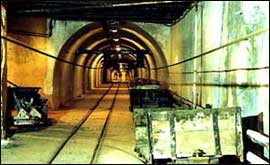 | | A tunnel in Monkton Farleigh |
By 1963 military thinking, however, had turned away from conventional arms to nuclear weaponry which didn't require a lot of storage.
All the conventional weapons stores were literally abandoned virtually overnight.
"Monkton Farleigh had closed down 2 years before we found it," says Nick "the MOD had just walked away from it.
"They’d left everything intact all the power on just literally abandoned it…"
Monkton Farleigh is one of numerous underground citadels, factories, bunkers and command centres hidden deep under the Wiltshire countryside.
Click here for more information on Secret Underground Cities. | | | |
|
|




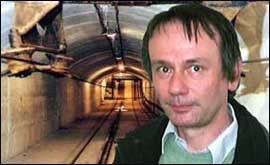


 100 feet below ground
 View a


 More
More