

Albatross
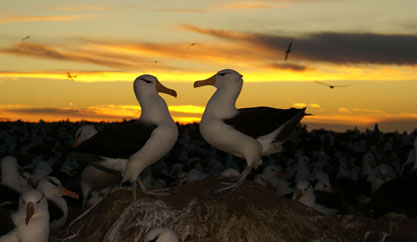
There are 22 species of albatross. In 1994, seven were threatened with extinction and today this has increased to 19. The cause is simple: albatrosses are getting caught on long line fishing gear as they try to eat hooked fish. Around 100,000 albatrosses die this way each year and the birds reproduce too slowly to replace these losses.
Wildlife Finder: find out more about albatrosses.
Charity:The Royal Society for the Protection of Birds (RSPB) with Birdlife International
Project:Saving the Albatross - the Albatross Task Force
Where in the World?Brazil and South Atlantic
Grant:Two grants totalling £66,955
How your money has helped
Around the world, fishermen set extremely long fishing lines, which drift through the ocean. Attached are thousands of hooks baited with fish. Albatrosses often try to feed from these hooks and unwittingly become trapped and drowned. The problem is so bad that most albatrosses are now threatened with extinction.
The BBC Wildlife Fund provided the Albatross Task Force with grants totalling £66,955 to help teach fishermen in the South Atlantic how to avoid catching seabirds in their fishing gear. This support enabled two task force instructors to be employed for 18 months and work with fishing fleets off the coast of Brazil, a hotspot for albatross deaths.
Fabiano Peppes was based in the port of Santos and Ricardo Hoinkis worked in Itijai, another important fishing port. Both were forging relationships with their local fishing fleets by setting up workshops in the ports, visiting moored boats and sailing with them. Fabiano and Ricardo helped teach fishermen how to avoid catching seabirds in their gear and how to fish more sustainably. They also collected vital data on how many seabirds were killed by fishing gear in the South Atlantic.
The ATF is also working in South Africa to disseminate seabird conservation information and to demonstrate best practice measures on board vessels to reduce seabird by-catch. Conducting research on board local and foreign fishing vessels is a large part of that process. Research findings are made available to the fishing industry, general public and in relevant national and international meetings.
One mitigation experiment currently underway in South Africa is the commercial testing of the Hook Pod. The hook pod is designed to protect the barb of the hook to prevent seabird by-catch. A pressure-release mechanism releases the baited hook at depth once the fishing gear is beyond the reach of scavenging seabirds.
Outlook
The loss of albatrosses to longline fishing is a solvable problem.
Research shows that 90 per cent of all albatross deaths due to longline fishing are easily preventable. In the future we need to continue to engage with and help educate enough fishermen to sustainably catch fish in a way that does not harm seabirds. In turn, local communities benefit from the increased food security arising from more sustainable fisheries. From the project so far it looks as if this work is already partly sustainable. The efforts in ports and on fishing vessels has strengthened relationships so much that there has been a voluntary adoption of safe albatross fishing methods on over 40% of the fishing fleets in Santos and Itajaj. The Task force were also extremely pleased to see the government pass fishery regulations that now require all fishing vessels to use appropriate fishing methods after several years of hard work. The outlook is looking hopeful and well on its way to ensuring the survival of this iconic species.
Did you know
- The wandering albatross has the longest wingspan of any flying bird. On average, the tips of its wings are 3.1 metres apart.
- Albatrosses have few natural predators, and some live for up to 60 years.
- There are four general types of albatross: great albatrosses, mollyhawks, north pacific albatrosses and sooty albatrosses. The wandering albatross is a great albatross.
- Of the 22 species of albatross, 19 are threatened with extinction. Two are classed by the World Conservation Union as critically endangered, seven are endangered and 10 are vulnerable. Longline fisheries are the principal threat for most species.
- Birds divorce each other as readily as people do, with males and females splitting up between mating seasons. The wandering albatross is one species that remains utterly faithful, however, having a divorce rate of zero per cent. They breed only when they are fully mature - this can take as long as 12 years. They produce just one chick at a time, and several albatross species only breed every second year.
See a full breakdown of the grants we awarded to organisations around the world
BBC iD
BBC iDBBC navigation
BBC links

BBC © 2014The BBC is not responsible for the content of external sites. Read more.
This page is best viewed in an up-to-date web browser with style sheets (CSS) enabled. While you will be able to view the content of this page in your current browser, you will not be able to get the full visual experience. Please consider upgrading your browser software or enabling style sheets (CSS) if you are able to do so.
