


That began to change during the Victorian age, when Welsh consciousness, particularly in the cultural and linguistic spheres, started to rise.
In the modern age, the process has continued apace. Since the second world war, increasing numbers of political and cultural institutions have begun to work on an all-Wales basis. Until the election of Tony Blair in 1997, however, this was overseen by the Westminster parliament and the Secretary of State for Wales (a Cabinet position since 1964). Following the referendum in September 1997, the National Assembly for Wales was created; more and more of the day-to-day political decisions affecting Wales are taken at this level. Some of the major national institutions include:
The University of Wales (1893) The first national institution of the modern age, the federal University of Wales now encompasses colleges at Bangor, Aberystwyth, Lampeter, Swansea, Cardiff, Newport, Wrexham and Carmarthen. Cardiff University now operates independently, but is affiliated to the national body.
National Eisteddfod (1880) The modern-day Eisteddfod is a massive annual festival that moves between the different regions of Wales.
The National Museums & Galleries of Wales (from 1907) The NMGW's earliest site is the splendid National Museum in central Cardiff: a fabulous place to get a good take on the history and development of Wales. Since the early days, other sites have been added, including:
- National History Museum, St Fagans, Cardiff. A fabulous open-air history of Wales in buildings.
- National Slate Museum, Llanberis. The story of north Wales' staple industry.
- National Mining Museum (a.k.a. Big Pit), Blaenafon. An old coal mine turned into a hugely informative and entertaining museum.
- National Waterfront Museum, Swansea. Brand new, hi-tech sweep through the industrial and innovative spirit of Wales.
The National Library (1907) Aberystwyth's pride is the magnificent Portland stone National Library; one of the UK's copyright libraries, so that everything published in Britain is found here. There is a particular emphasis on Welsh collections, which are superbly housed and presented. The library includes the National Screen and Sound Archive.
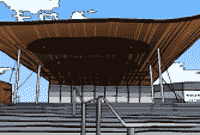
The National Assembly for Wales (1999) The 60-member National Assembly, elected every four years, is responsible for all devolved matters in Wales, such as health, education and transport, with increasing powers heading its way from Westminster. It meets in the striking new Senedd building in Cardiff Bay.
Political parties Plaid Cymru, the Party of Wales, was founded in 1925 and gains most of its support in the north and west of Wales. The main UK parties all have semi-autonomous Welsh branches. Labour have been Wales' largest party since 1922, even at the height of UK-wide Conservative popularity.
Sports Rugby Union is Wales' national sport: the Welsh Rugby Union was founded in 1881. The national team perhaps peaked in the 1970s, but the 2005 Grand Slam in the Six Nations championship was a welcome reminder of glory days. In 1999, Wales was the host nation for rugby's World Cup. Wales also play as a national side in football, though with little of the success of their rugby counterparts. Wales also compete as a separate nation in the four-yearly Commonwealth Games.
Others
The Wales TUC was founded in 1974, and has a far higher proportion (45%) of the Welsh workforce in membership than across Britain as a whole. BBC Cymru Wales, ITV Wales and Sianel Pedwar Cymru (S4C) are the main national broadcasters. Government bodies include the Wales Tourist Board, Cadw (the national heritage agency), the Welsh Development Agency and Bwrdd yr Iaith Cymraeg (the Welsh Language Board).
Page 1


Ann Rowlands living in Canada, originally from The
I just came across this site last week and I think it is really good. I never learned the Welsh language when I was going to school in Wales but now that I am older, I now wish I had of. It is so nice to hear the welsh language on this site. It is good to know that the welsh language is being taught in schools. No matter how long I have been away from Wales, my heart belongs to the hills and valleys in the Rhondda.
The BBC reserves the right to select and edit comments. To submit a larger contribution please contact us.