

Last updated: 07 December 2009
From driving our cars to powering our laptops, everyday life in 21st century Wales is highly dependent on power supplies. But with pressure to reduce carbon emission and predictions that oil could run out by 2020, alternative sources of energy are being considered. As part of the BBC Wales Green season in December 2009, our environment correspondent Iolo ap Dafydd assesses the challenges facing Wales.
Energy generation and industry are the two biggest emitters of carbon dioxide. These two areas then will feature more than many, when it comes to talks about carbon reductions, and paying for it.
Essentially, in Wales whatever the UK government agrees to in Denmark, is beyond the assembly's control. Equally half of the emissions in Wales are not devolved. That is, they do not come under Cardiff Bay control. All power generation for example, over 50 megawatt in power, comes under the Department of Energy and Climate Change (DECC) in Whitehall. The old BERR - business and enterprise department.
And yet, Wales has its own renewable energy targets. Just like the UK government with its 15% of power from renewable sources by 2020, the assembly government also wants to encourage more wind and solar power.
But the difficulties with that policy are many. Even though Wales' Environment Minister Jane Davidson says that less than a dozen vocal opponents of wind farms actually write to the press and media to voice their disapproval of building wind turbines, there is opposition to almost every wind farm being planned across the country.
Wind power
WAG will miss their 2010 target of energy from wind, in a fairly spectacular fashion
Wind farms are divisive because many opponents feel they are intrusive in areas of outstanding natural beauty, and many others question how efficient they are.
There is no doubt though that the newer turbines with their gearboxes and electronic components, are a great deal better - and bigger - than the early wind farms built in the 1990's. Doubts abort radars, affecting wildlife and birds and to some extent whirring noises, seems to have faded away.
But despite cultivating a policy to build turbines - by mostly private equity - in 7 specific areas of Wales, the archaic planning system, National Grid, narrow roads in remote counties as well as "not near my home" crowd, have meant that WAG will miss their 2010 target of energy from wind, in a fairly spectacular fashion.
Only four wind farms were completed in 2009 - one out to sea, with hardly any neighbors to moan about the location. Wind gets the lion share of investments, subsidies - through the renewable obligation certificate (ROCs).
The answer may not be all blowing in the wind, or warming our roofs via the sun
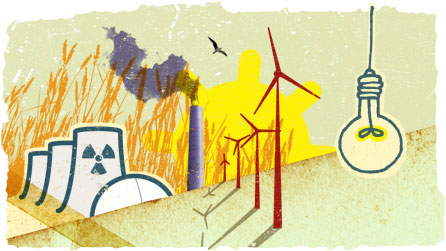
Solar and nuclear power
In terms of clean green energy, solar is a poor distant cousin, despite potentially it could be far more popular, even more widespread The UK government with it's new feed-in-tariffs from next April will allow any homeowner or business to reap a quicker reward from investing anything upwards of £8,000, by placing photovoltaic solar panels on their roof.
But as with any renewable energy source, its intermittency is seen as a weak point. That's why this Labour government in London is also supportive of nuclear power. This, it says, backs up the renewable energy mix, with real muscle.
In Wales, Wylfa may cease producing electricity by December next year. A new reactor - Wylfa B may be online by 2019 says E.on, one of the companies bidding to bvuild new nuclear power stations in Britain.
What worries all governments is the dreaded energy gap - that by 2015 - with old nuclear and dirty coal power stations closing, there could be a shortfall. And the answer may not be all blowing in the wind, or warming our roofs via the sun.
Greenhouse gases
There isn't enough time or capacity to build the wind turbines and extra nuclear power stations required
And there are carbon emissions. Of course one real way of reducing CO2 emissions is to reduce the emitters. Population control has been tried in China - no politician has dared to request a cut in the number of people in Wales or Britain yet. Yes, recycle, reuse and reduce, has been used as a slogan - but half the problem currently with our energy and emission targets are that only half the problem is being looked at.
I only have to remind readers what the Institution of Mechanical Engineers said recently. That the UK government plans to make carbon emission cuts of 80% by 2050 are physically impossible to achieve, because there isn't enough time or capacity to build the wind turbines and extra nuclear power stations required.
Under current plans, the targets will not be met until 2100, it argues.
Dr Tim Fox is head of environment and climate change at the Institution. He says that the problems of building the infrastructure haven't been thought through.
"We'll be competing for the engineering resources to deploy those wind farms in a global market where lots of other nations are trying to de-carbonise at the same time. We've done an assessment of the level of kit that is needed and it is at a level of building and construction and deployment that is unprecedented in modern times."
This has been dismissed by a spokesman for DECC as, a ".. can't do, won't do attitude ..." and of being ".... defeatist ...ahead of the crucial climate change talks in Copenhagen."
One final thought, since our steelworks closed, and the coal mines were considered uneconomic, is Wales about to become a major generator of electricity for England as well as for ourselves? Already we contribute 11% electricity output over and beyond what we use in Wales. In a slow devolution process, that could throw up some interesting political questions in the future.
By Iolo ap Dafydd, BBC Wales Environment Correspondent
Find more Welsh perspectives on environmental questions below.
The Issues







See also
Elsewhere on the web
What can I do?

Bloom green guides
Is it worth recycling? What is fair trade? Take a closer look at the burning issues.

