Homes Iron Age Celts lived in houses - but they were very different to the houses we live in today! Large families lived in a roundhouse. The walls were made of daub (straw, mud and tail) and the roof of straw. Iron firedog 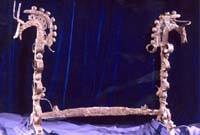  The Celts would light a fire in the middle of the roundhouse for cooking and heating. A farm worker found this iron firedog in 1852 near Llanrwst, north Wales. It was found lying on its side, with a large stone at each end, and deeply buried in peat. The Celts would light a fire in the middle of the roundhouse for cooking and heating. A farm worker found this iron firedog in 1852 near Llanrwst, north Wales. It was found lying on its side, with a large stone at each end, and deeply buried in peat.
Archaeologists believe it was a gift to one of the Celtic gods or goddesses. In the roundhouse, firedogs would have been placed as decorations either side of the central fire. Perhaps they showed the status of the family. The blacksmith who made this firedog was very skilled at shaping and working iron. At either end of the firedog is an animal's head and neck - it would have taken a lot of time, effort and skill to make. Roundhouses 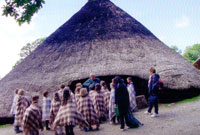 This is a reconstructed Iron Age roundhouse, built on a hillfort site in Castell Henllys, Pembrokeshire. This is a reconstructed Iron Age roundhouse, built on a hillfort site in Castell Henllys, Pembrokeshire.
Iron Age people would have chosen where they lived for different reasons. The chieftain and his family, soldiers and craftsmen, lived in a hillfort because they were easy to defend. There are over 1000 Iron Age hillforts in Wales. Steep slopes, a high wall and deep ditch helped keep the Celts safe in their homes. Farmers lived on the land they farmed. Sometimes farms would be built in spots with a good source of water, or fertile ground of good pasture for the animals. The Celts grew corn and kept cows, pigs, horses, goats and sheep. The hillforts didn't keep the Romans out though and the Celtic tribes were conquered when the Romans invaded in AD43. ©NMGW
|