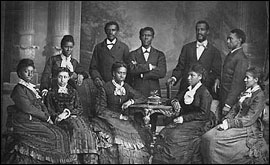
One of the legacies of black presence in Britain is the modern wealth and prosperity of cities, such as Liverpool and Bristol, that were built on the profits of the slave trade.
However, Tyneside played an influential role in the abolition of slavery. There had been a recent and dramatic experience of English white working class solidarity with the 'black cause' - the abolition of slavery in the United States. Much has been chronicled about American abolitionists and fugitive slaves who made frequent trips to Tyneside to speak at meetings held by the Gateshead and Newcastle Anti-Slavery Society. Tyneside Cottons on 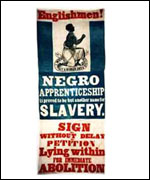 | | Poster advertising an Anti-slavery meeting |
When the workers of the Lancashire cotton mills lent material support to the anti-slavery cause, they found solidarity on Tyneside. A great effort was launched to collect money and clothing to sustain Lancashire cotton workers.
However, Newcastle magistrates refused a licence to the Tyne Concert Hall for a benefit night in aid of the Lancashire Distress Fund.
This was just one example of the Tyne Concert Hall's long running battle with the Magistrates over 'unbecoming activities'. Tyneside Against Racism
Racism was evident on Tyneside about this time, but there were a number of liberal journalists, working for the Newcastle Daily Chronicle (today's Evening Chronicle) who spoke out against hostility towards black people. | "We deplore the prejudice against colour, and we are severely censorious towards those who exhibit it." | | Newcastle Daily Chronicle, January 1865 |
In early Victorian times, Britain's black population mainly consisted of African and Arabic sailors and black refugees who had fought for George III in the American Civil War. The predominantly male, black population integrated and intermarried into poor white urban populations. Minstrels and Midfielder's Throughout Victorian Britain, many Black people in were involved in sports and entertainment. 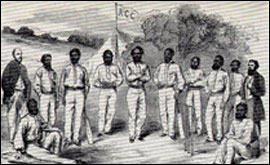 | | Aboriginal Cricketers Touring 1868-7 |
In 1868 very first Australian cricket team to visit England was Aboriginal. They played a match at North Shields, enthralling crowds with displays of boomerang throwing as well as cricket.
Earlier, in 1862, an American touring concert party, The Real Blacks, challenged local cricketer's to a match on Newcastle's Town Moor, and won. The Black Diamond of Seaton Burn 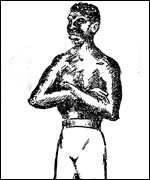 | | The Black Diamond |
A black boxer who lived in the village of Seaton Burn in the eighteen century. Detail taken from WC Irving's painting of 'The Blaydon Races'.
Many black people arrived in Britain out of desperate bids for personal freedom.
The Tyne Concert Hall The Tyne Concert Hall, Nelson Street, Newcastle was a principle centre for working-class entertainment, and the usual venue for black artists. In 1861, The Original African Opera Troupe, raised funds for Newcastle Infirmary at a charity benefit, returning in 1862 and sang extracts from Italian operas. 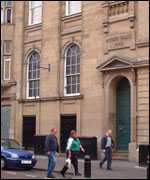 | | The Tyne Concert Hall, Nelson Street, Newcastle |
The Female Christi Minstrels were seven young black women who came to Newcastle in 1860, spicing their act with political jokes. Black entertainers continued to be engaged on a regular basis at the Tyne Concert Hall right through the 1860's.
The Ohio Minstrels, a group of ex slaves, caused much concern with the local Tories and Whigs who could not stand the Hall's 'radical proprietor'. |