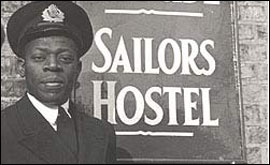
| 100 years ago the thriving port South Shields attracted tradesmen and seamen of many nationalities; Yemen, Aden, Somalia, African, Indian and Malaysian. Foreign seamen had come to South Shields in the 19th Century and were used as cheap labour on the ship, usually as firemen and stokers. 1919-1930 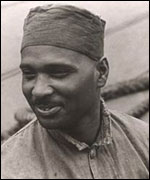 | | South Asian seamen or Lascar, circa 1920 |
During WWI, foreign labour had been used to keep the Merchant Fleet running, while British seamen were drafted into the Royal Navy. In the years leading up to and including WWI there were almost 2000 members of the black and minority ethnic community living in South Shields. They were to represent the first significant Muslim communities to settle in Britain. After WWI foreign (mainly Arab) seamen found their position was changed from that of being welcome, to now being seen as unwanted guests. The demobilisation of white British seamen and the onset of the economic depression between the wars resulted in declining employment and intense competition for jobs. Racial unrest 1919 saw the first serious street violence and racial unrest in areas inhabited by foreign seamen, with attacks on Arab Boarding Houses and cafes. Throughout the 1920's and 1930's popular feeling in the town seems to be firmly against the Arabs. A constant stream of letters to the Shields Gazette on the subject of the Arab seamen in the town shows the strength of hostility and racial prejudice. It was around this time the 'Minority Movement' a left wing group of black and white workers formed to challenge the National Union of Seamen and the Shipping Federation, who were under-representing and failing to defend the welfare of foreign workers. The Mill Dam Riots Throughout 1930, the Minority Movement held public meetings at the Mill Dam to campaign against a new rota system which they felt discriminated against the Arabs.
Violence over the dispute erupted in North Shields on April 29, 1930 when 13 Somalis were brought over from South Shields to sign on as Firemen on a ship. A large crowd of white seamen tried to stop them reaching the Union Office. The Somalis were then attacked and, despite drawing their knives, were severely beaten. The Arab Riot On 2 August 1930, South Shields was to gain national notoriety at the time of the so-called 'Arab Riot' at Mill Dam on the Quay. In East and West Holborn, South Shields, the Arabs had their own community, cafes and boarding houses. Rumours circulated round Shields that the Arabs used bribery to get jobs on the ships, thereby "robbing" white seamen of jobs. The Minority Movement 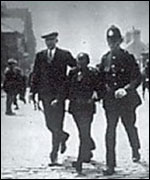 | | Police arrest an Arab man at Mill Dam August 2, 1930 |
A large mob of white seamen then roamed the waterfront hunting for any Arabs and foreigners.
A number of Arab workers gathered outside the Shipping Foundation Offices at the Mill Dam to hear rousing speeches from the leaders of the Minority Movement.
Trouble began about noon when four white men were hired for the steamer Etheralda, and expecting trouble, the police were drafted into the area.
Ali Hamid, one of the jobless Arabs was heard to shout "They work, but there is no work for the black man". There are conflicting reports about what triggered the resulting chaos, but there was soon furious fighting between a group of white seamen and the Arab crowds. Police drew their truncheons and charged, only to be met by a hail of stones and shouts of abuse. Once among the crowd, the Arabs drew their knives, stabbing four Policemen. The Police waded in with their truncheons as the riot spilled over into nearby Holborn, injuring dozens of innocent bystanders. 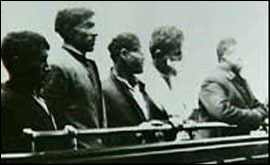 | | Arabs 'rioters' were imprisoned and then deported |
On Monday morning, the public gallery in the Magistrates was full, with an estimated crowd of 1,000 outside. Six white men and 20 Arabs were brought from the cells and accused of causing an affray or riot. A collection of knives, sticks, chair legs and other weapons was displayed, before they were released on bail of £10 each. A petition signed by 500 South Shields Arabs was sent to the Home Secretary to voice their grievances, but all to no avail. Little was done for the Arabs; scores of them had to be admitted to Harton Workhouse as their money ran out. Nearly 100 Arabs, not implicated in the riots, were deported.
On November 20, after a two day trial at Durham Assizes, all the Arab defendants were given sentences of hard labour, ranging from three to 16 months. After serving their sentences they were to be deported. The white Minority Movement organisers got eight months each.
Divide and Rule The so-called Race Riot also revealed the solidarity between conscientious white seamen and their black colleagues. That solidarity was a threat to the ship owners and unions, who favoured 'divide and rule'. 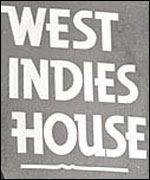 | | During WWII, servicemen's Boarding Houses were ethnically segregated |
During WWII, many of the 3,000 plus Shields seamen killed were black, though there is little recognition of this on the town's war memorials. By the 1940's, the black community of Shields began to widen their employment opportunities, opening cafes and restaurants. There were also a few other settlers who worked as door-to-door peddlers. Improper behaviour In 1945, allegations were made of attempts by the police to drive away the custom of black owned business. False claims of undesirable activities such as drugs and prostitution were made against the cafes proprietors. Cafe owners were regularly subjected to racial and physical abuse. Frank Lambert, a local solicitor, said at the time:
"The coloured population felt itself victimised and hounded out." Short of evidence, the police eventually tried to prosecute two Indian men in South Shields on the grounds of permitting prostitutes to assemble in the area. They were fined £5 each. The two men appealed and the hearing was stopped charging all court costs to the police.
|