Filming the impossible
Keith believes that one of the reasons for Touching The Void's success is that it puts the viewer at the centre of the action.
"The film asks the moral question 'what would you do in those circumstances?" says Keith.
Keith and the film's director Kevin MacDonald wanted to make the mountaineering scenes as authentic as possible.
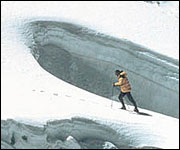 | | Joe Simpson tackles a glacier |
"We didn't want to make it cliffhangerish, over the top and unbelievable. Then it would have become a joke. We wanted to make it as real as possible."
The team also had to make it as safe as possible for the production crew. Keith and his fellow team members' motto is always "safety first" - as with previous shoots, they spent a considerable amount of time sorting out health and safety matters.
The work was painstaking as Keith explains, "It took two-three hours accessing a camera position and setting up."
At no time did Partridge feel at risk, "I've been in those environments before and you know the game."
"There was only one split second when we went up to do summit shooting and we had to climb down a loose gully. Going up was fine but going down a few rocks went flying past. You have to keep your head and keep cool."
Partridge says that his team try to eliminate or minimise any risks, but there are limits. "Yes, we would withdraw if we felt at risk," he says.
Cliffhanger
One of the key scenes in the film comes when a climbers rope is cut. The scene was shot in the Jungfrau in the Alps and it's perhaps the sequences that Keith is most proud of.
"We did it all for real. When you see someone fall 80 feet, they fall 80 feet. The rope really went zip-zip-zip."
Keith still gets a tingle down his spine when he watches the scene, "The building up of the tension to the cutting of the rope is just mind-blowing - it really gets me."
"We used fantastic rope engineering - you could've hung a bus off that rope. We did the scene in just two takes.
"Everything in the film was for real - only two aerial shots were computer generated. Even the climbing sequences were done on ground that matched the terrain that Joe Simpson would have been climbing."
Weathering the conditions
Some of the hardest sequences to shoots were in bad weather including the ascent of the mountain early in the film.
"It was hard to do personally and professionally purely because of the conditions we had to work in. All the big storms were real. Some days it was minus 20 degrees with winds of 40-50 miles per hour," he recalls.
"When you see the bad weather, it was bad weather. What we did was to transport the viewer lock, stock and barrel onto the mountain."
When Keith's team were filming in Switzerland, the weather was so extreme that the camera lens and viewfinder would fill up with snow in a just a few seconds.
It was a superhuman feat of endurance. Visibility was sometimes less than six feet. It was a constant battle against the elements.
It was also hard for the actors and their stunt doubles, leaving Keith to reflect that "this is as raw as it can get." Inside the void One of the most impressive scenes in the film comes when Joe Simpson finds himself inside a huge crevasse the size of St Paul's Cathedral dome. 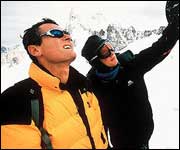 | | Joe and the director prepare a scene |
Most of this was actually shot by Mike Eley the Director of Photography mainly because it is relatively easy to shoot inside a crevasse once it's rigged - ladders, scaffolds etc. I did the point of view type stuff. "You need specialist knowledge of course, as anyone going into a crevasse is dicing with death. We were using very sophisticated safety techniques. You can strap ladders down, put in scaffolds and engineering. If you do make a mistake, it's pretty serious." Vertical Limit? So what does Keith make of Hollywood's roll call of mountaineering movies from Cliffhanger and K2 to Vertical Limit? "I think they have their place. It's great entertainment but it's not real. It's not the essence of mountaineering. It doesn't transport the viewer there." Keith does have a soft spot for Vertical Limit, the explosive mountain drama starring Scott Glenn and Chris O'Donnell, despite its lack of authenticity. "It's so laughable especially the scene with the nitro-glycerine," laughs Keith. "Taking nitro-glycerine up a mountain, now that is crazy." Next challenge So would Keith ever be tempted to recreate the Simpson and Yates' Siula Grande expedition for real just for the hell of it? "No, I wouldn't. The ascent and descent has only ever been done by Simpson and Yates. It was a remarkable achievement. Nobody has ever recreated it in full. Two guys once got to the top but they abseiled down". Since Touching The Void, Keith Partridge has been involved in more dramatic location shooting on the new Alien 5 film. "The Alien team had been to see Touching The Void and they were gob smacked by the realism," says Keith. As a result Keith found himself in France shooting the opening shots of the film involving a female ice climber 500 feet above a waterfall in Chamonix. This time the filming posed yet another challenged - for much of the time he was working in mid-air. The results are, by all accounts, pretty amazing. "It is an enormously spectacular shot," says Keith proudly. But Keith isn't resting on his laurels back at base camp - he believes he's only touched the surface of what's possible in the world of extreme location photography. "There's also buildings, bridges and other structures not just mountains," he says enthusiastically." Anyone thinking of making a dramatic film shot high above the Tyne or Wear Bridges, take note! You can't help feeling that Keith Partridge still has a lot of tricks up his sleeve when it comes to filming the impossible! |