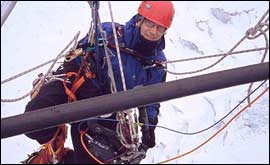
|  | Trained and employed by the BBC in Newcastle for six years, Keith now specialises in adventure filming, developing new techniques and working in extreme locations.
Early exposure
Becoming a climbing camera man is a very specialist and potentially dangerous job, so how did Keith Partridge swap his warm, cosy job in TV in Newcastle for the cold extremes of mountaineering movies?
"It started back in 1990 when I was reading a book called Filming the Impossible by Leo Dickinson. I was a keen hill walker and I decided to pack in my job and combine my interests in filming and mountaineering," explains Keith.
 | | A steep learning curve |
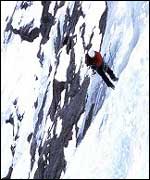
"I spent two years on expeditions travelling all over the world and building up my expertise".
After one of his early expeditions Keith came back from Iceland and was offered the opportunity to work on his first major climbing film in the Himalayas with Chris Bonington.
"It was like a dream come true. It fuelled the fire. Hardly anyone was really doing extreme climbing photography at the time," says Keith.
"I was then lucky to secure work on a BBC 2 series about the history of mountaineering called The Edge".
Partridge's next project, Touching The Void, was to test his expertise to its very limits. Surviving the void
Touching The Void is an extraordinary and epic tale of adventure and survival. It reconstructs the true story of the fateful climb which British mountaineers Joe Simpson and Simon Yates undertook in the Andes in 1985.
The film combines documentary and dramatic reconstructions of the ascent of Siula Grande which nearly killed the two climbers.
Partridge was approached two years before filming began. "It was on and off. Some even doubted whether the film could actually be made," he recalls.
Keith works as part of a highly specialist team, "We've built up a huge track record, developing techniques for accessing areas that were difficult to get to and experimenting with lightweight kit."
Finally it was all systems go and filming got underway - it was then that the hard work began.
"We were pretty terrified that we wouldn't be able to pull it off," says Keith.
Perilous journey
The film was shot on location in the Alps and the Andes including Siula Grande in Peru, the mountain where the original climb actually happened.
 | | How far? |
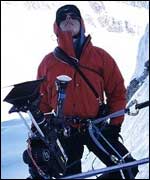
Shooting on Siula Grande was a huge challenge - it's an unforgiving environment with the risk of frostbite, altitude sickness and hypothermia.
"The snow features in South America are unique. To get those wide shots and a sense of the scale and realism, you have to go back," says Keith.
The working conditions were difficult - Siula Grande is extremely isolated and its base camp is at a higher altitude than Europe's highest peak, Mont Blanc.
"Siula Grande is 21,000 feet high and I suppose we were working at around the 18,500 feet mark. There's no helicopter and no medical facilities at hand," says Keith.
But he knew what to expect, "I'd been on Siula Grande before, trekking, so I knew what we were letting ourselves in for. Even so, acclimatisation took a long time."
"We were pretty well equipped for altitude sickness and cold injuries. We also had an expedition doctor with us who was highly experienced in the area of cold injuries."
Keith's first reaction at being on Siula Grande was, "My God, this is enormous. How the hell did Joe Simpson ever climb it? We were all awestruck at Joe's achievement."
It was also the first time that Joe had been back to the mountain since his near death experience and epic survival in 1985.
"I shared a tent with Joe high up on the glacier and we stayed up talking. We had a good time but I think that Joe found it very difficult going back."
"Joe said that it had taken him 17 years to put his ghosts to rest, now he said that it was going to take him another 17."
|