| | |
| | |
| 29 October 2014 |  |
| BBC Homepage England | |
| ||
| » | Tyne News Sport Travel Weather Going Out Have Your Say Competitions Webcams Sense of Place Features Site Map | |
| Contact Us | |
| Monks At Work The making of The Gospels | ||||||||
 | ||||||||
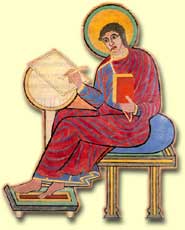
Eadfrith, writer and illustrator of the Lindisfarne Gospels Close examination has shown that this awe-inspiring work of the Lindisfarne Gospels’ script and illustrations was undertaken by one artist-scribe, whom the 10th century monk Aldred identified as the Lindisfarne bishop Eadfrith. The work formed a personal opus dei, or task done for God and the community.
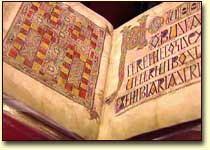
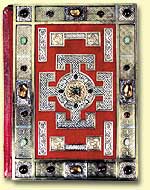
Making the Lindisfarne Gospels The Lindisfarne Gospels were written and painted on vellum made from calf skin, which had been soaked, stretched, and scraped clean. Each skin provided a double sided double-page spread, and approximately 130 skins would have been needed to make the book, which has 259 written and decorated leaves. Before writing, 4 large sheets of vellum were stacked, and folded in half, to form a gathering of 8 leaves, 16 pages. To make the book, gatherings of 4 sheets of vellum were sewn onto leather cords, the ends of which were threaded into thick wooden boards and secured with wooden dowels. Then the boards and spine would have been covered with damp leather. Binding the Lindisfarne Gospels Aldred's inscription, added in the 10th century, recorded that the Lindisfarne Gospels were bound by Ethelwald and the cover decorated with an impressed design.
A jewelled casing was added to the book by Billfrith the hermit priest. Both Ethelwald's and Billfrith's work has disappeared, probably removed by Henry VIII’s commissioners when the dissolution of the monasteries was ordered in around 1536. However, the cover and casing may have resembled those of the small book of St John's Gospel and the St Cuthbert portable altar, both placed in St Cuthbert's new tomb in 698. Writing and decorating materials Few other early manuscripts are painted using such varied colours as the Lindisfarne Gospels. The inks used to decorate the pages were pigments ranging from locally available vegetable dyes, plant extracts and minerals, to lapis lazuli, which had to be brought from the Himalaya mountains in Asia. The ink was made from soot, and other natural materials. In total about forty different paint pigments may have been used. Gold was also used in the illustrations but only in tiny amounts. Eadfrith’s pens were cut from feathers, probably goose feathers, which were easily available around Lindisfarne. Brushes were used to apply the paint colours, and tiny hairs from the brush have been found in places in the paint. The text of the Lindisfarne Gospels The Lindisfarne Gospels’ scribe, Eadfrith, would have copied his text from an existing book. This was probably one of the many books brought back from Rome by Benedict Biscop. Italian features of the Lindisfarne Gospels include the way the text is laid out in two columns and mention of the Italian St Januarius in an introductory page. Eadfrith's text closely follows the revised Latin version of the Gospels known as the Vulgate, written in the late 4th century by St Jerome. Before writing the text, fine lines were ruled onto the pages with a metal point between prick marks at either end of the lines. For his text Eadfrith used a type of script known as Insular majuscule, which was developed in British and Irish centres of Celtic Christianity. This was a form of the rounded Roman uncial script. In some places, however, Eadfrith wrote text headings in a lettering style influenced by Anglo-Saxon runes (symbols). Small decorated initials appear in the introductory text before each gospel. Few other Anglo-Saxon texts have such elaborate minor decorated initials. Approximately 250 years after the Lindisfarne Gospels book was written, a translation in Old English, Anglo-Saxon was added by Aldred, a priest at Chester-le-Street from 950 to 970. This word-for-word translation was written between the lines of the Latin text. It is an important early Anglo-Saxon document and is the first surviving version of the Gospels
of script known as Insular minuscule The decorated pages in the Lindisfarne Gospels In the Lindisfarne Gospels book there are 15 elaborately decorated pages in groups. Each of the four gospels is introduced by a picture of the saint, followed by a page of decoration based on the form of a cross - this is known as a cross-carpet page - and then a major initial beginning a page of decorated text. There is also an introductory cross-carpet page and a major initial page at the beginning of the whole manuscript, and another decorated initial page to mark the beginning of the Christmas Gospel in Matthew. Figure decoration in the Lindisfarne Gospels The saints illustrated in the gospels are shown wearing Roman/Greek dress of the late 4th or 5th century, and most probably Eadfrith based them on images in the large collection of books and panel paintings from Italy in the library of the joint monastery of Monkwearmouth and Jarrow. These are the only figures in the Lindisfarne Gospels apart from a tiny profile head on the major initial page of St John’s gospel. Birds and animals in the Lindisfarne Gospels The Lindisfarne Gospels book is unusual for its large quantity of bird illustrations, and their naturalistic detail. Although they are arranged decoratively, they show observation of real birds, such as shags and herons, which would have been plentiful around Lindisfarne at the time. The eagle, the traditional symbol of St John, is so naturalistic that Eadfrith may have drawn one from life. He also included very distinctively drawn cats, one of which stretches up the major initial page of St Luke’s Gospel, with its elongated body filled with birds. Working out the designs The designs of the large decorated pages are amazingly complex. Eadfrith probably worked out his design first on wax tablets or scraps of vellum. Then the design was drawn lightly onto the back of the page using compasses and dividers and a hard metal point, and the main lines pricked through. However on the major initial pages Eadfrith must have done much of his drawing freehand, as the shapes are so varied and complicated. Occasionally Eadfrith introduced what seem to have been tiny deliberate mistakes, no doubt to acknowledge that perfection could belong only to God. |
| About the BBC | Help | Terms of Use | Privacy & Cookies Policy |