The Corridor of Culture
Witness its Magnificence
For over 1,600 years, merchants, traders, monks and soldiers who journeyed to China’s ancient capital of Xi’an to witness its magnificence travelled via the Silk Road. Now a UNESCO World Heritage Site, discover what makes this former trading route so special.
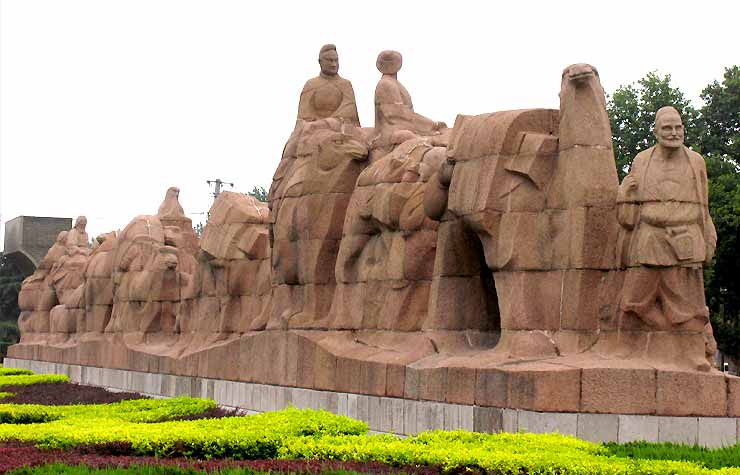
Conjuring up images of merchants on camel-led caravans, pilgrims braving bandits on the open road and bazaars of the Far East filled with treasures beyond imagination: the mere mention of the Silk Road to any medieval adventurer would have them wide-eyed with wonder. This transcontinental trading route was the main corridor between the East and West for centuries, beginning and ending in the ancient Chinese capital of Xi’an.
The road derives its name from the lucrative trade in Chinese silk carried out along its length, with the early origins of the route emerging during the Han Dynasty in 206 BC. This was significantly expanded in 114 BC and dealings on the path became a major factor in developing classical civilisations of China, India, Persia, Europe and Arabia. The ability to trade goods facilitated long-distance political and economic interactions between nations and, though silk was certainly the major trade item from China, many equally important commodities were exchanged – including religions, philosophies and various technologies.
As Xi’an was the terminus of the route, Tang Dynasty emperors chose it as the city from which to rule the country due to its advantageous position and the immediate access to expensive merchandise that changed hands every day.
Legacy of culture
The origin of the Silk Road as we have come to know it begins in second century BCE. A general called Zhang Qian was sent to the Far West by Emperor Wudi of the Han Dynasty to make contact with Yuezhi, a nomadic tribe. The emperor feared the Xiongnu people – a group who previously attempted to invade the Kansu province of Han Dynasty – would try to make a rally for power. The Yuezhi were the enemies of the Xiongu, and so the emperor hoped to strike an alliance in order to defeat them.
Unfortunately, Zhang Qian was captured by the Xiongnu en route and imprisoned for ten years, during which time he married a nomad wife and had a son. However, he remained intent on completing his mission and eventually he escaped, continuing his journey further west. When he finally reached his destination in 128 BC, he was surprised to find the Yuezhi living in peace and no longer interested in taking their revenge on the Xiongnu.
On his return, Zhang Qian told the emperor of what he saw in the West, delighting him with detailed accounts of unknown kingdoms and tempting the emperor into dispatching successive missions. Each assignment returned with an increasing amount of luxurious Western wares such as fur, perfumes and even horses. Simultaneously, the demand for precious Eastern produce – predominantly cultivated silk – was growing rapidly, leading to valuable diplomatic contacts and economic relations between East and West.
The network of the Silk Road flourished during the Tang Dynasty and products like precious gems, exquisite clothing and spices were exchanged daily. At the height of its popularity, the route stretched 4,000 kilometres, reaching as far as the Mediterranean Sea and attracted famous travellers like Alexander the Great and Marco Polo.
The Silk Road maintained its status for over a millennium and a half, but it disintegrated in the 15th century when the Ottomans gained supremacy at Constantinople. Ottoman rulers of the day reviled Westerners because of the continuing crusades, so retaliated by embargoing trade with Europe. By the end of the Ming Dynasty, China was once again shut off from the outside world, thus ending centuries-old exchange of culture and religion between East and West.
A world treasure
Though it hasn’t been used as an official route for centuries, its historical importance remains and China has been campaigning for it to be recognised internationally for a number of decades. Starting in 1988, UNESCO (The United Nations Educational, Scientific and Cultural Organization) began to investigate the trade route’s role in promoting cultural diversity across the Eurasian hemisphere.
As the road spans so many countries and landmarks, the process of becoming a UNESCO World Heritage Site has been a long one. Originally, in 2008, China identified 48 sites along the Silk Road that could be of significance. But in 2011 UNESCO proposed that, due to the vast scale of the Silk Road, the application should be divided into corridors. A joint proposal from China, Kazakhstan and Kyrgyzstan encompassing a channel running from central China to the Tianshan Range of mountains was put forward and was approved by the committee in June 2014.
Sites that fall under this protective status include some of Xi’an’s most famous monuments, such as the Big Wild Goose Pagoda, Daming Palace and the Xingjao Temple. Other notable attractions include the tomb of the Silk Road’s pioneer Zhang Qian himself and the Bin County Cave Temple – a wondrously ornate Buddhist temple in the middle of the Chinese landscape. Even sections of the Great Wall are incorporated in this special passage.
The award of UNESCO World Heritage status means that even today the Silk Road connects China to the rest of the world through its dynamic heritage. The iconic conduit remains as a vein filled with cultural riches, leading back to the beauty of Xi’an in the heartland of the Shaanxi Province.
