Home > Activities > 3-4 years
Talking to your child is important, but equally, we should give them the time to think and respond in a conversation.
Watching and waiting for a response shows them that you're listening to what they're saying and encourages them to use longer sentences.
Child 1: Will you get me a plate?
Child 2: Okay!
Child 2: I brought you a plate.
Child 1: Okay, thank you.
GIVING THEM TIME TO THINK AND RESPOND CAN HELP IMPROVE THEIR LANGUAGE SKILLS
Child 1: What do you want today?
Mum: What would I like? I would like a pizza, please.
Child 1: Which kind of pizza?
Mum: What toppings do you have?
Child 1: I got these all toppings.
Mum: What are they?
REMEMBER TO WATCH AND WAIT
Child 1: Pepper, tomato, mushroom, cheese, pepperoni.
Mum: Ah! Can I have the tomato, cheese and pepperoni, please?
ASK OPEN QUESTIONS AND GIVE THEM PLENTY OF TIME TO ANSWER
Mum: Do I get a drink with my meal?
Child 1: Okay.
Mum: What drinks have you got?
Child 1: I got coffee, milkshake.
Mum: Ooh, can I have a strawberry milkshake, please?
Child 1: Okay.
Mum: Oh perfect, that's great. That's delicious.
How pausing and waiting can help your child learn
Pausing after you have said something, or asked a question, and waiting for a response can help your child to…
Have time to start communicating or respond to your actions or words
Show you what interests them
Learn to link the words they hear with their meanings
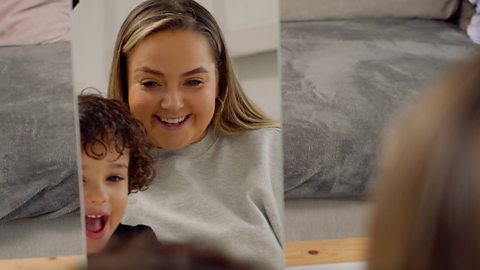
During play time you might talk about what has their interest, perhaps a toy pizza, like in the video above.
Pause and wait for them to respond before continuing. You can follow what they're interested in and chat about names, shapes, textures and features.
Why is it important to ask open questions?
Open questions encourage your child to respond with a sentence, rather than just ‘yes’ or ‘no’.
The mum in our film asks open questions like, 'What toppings do you have?' and 'What drinks have you got?', while role playing a pizza restaurant with her child.
Opening up the conversation allows both of you to continue chatting and taking turns to speak, while following their interests.
Follow your child's lead and focus on one object at a time.