Home > Activities > 3-4 years
Playing this fun twist on what’s in the bag using different textures is a great way to expand your child's vocabulary.
When your child experiences a word with more than one of their senses, their brain will create more connections to that word.
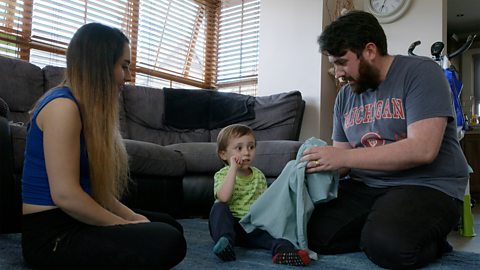
Watch the video below to see how our families incorporate lots of opportunities for language development into this sensory activity.
What does it feel like?
Smooth.
Smooth. We're going to play a game that's going to test your senses. Close your eyes. Now, you're going to put your hand in and you're going to tell me how it feels.
Does it feel soft?
Not soft!
Not soft? What's the opposite of soft?
Hard!
It's hard? And what shape is it?
Circle!It's a circle shape?
Okay…A band!
A band… and where does it go?
On your head.
Okay, let me see if you're right. Well done!
I'm going to shake them all up, yeah? Do you want to give it a shake? Good boy! Now, you put your hand in. Tell me what it feels like.
Soft.
Soft? What's that? What's that? What is it?
Squishy.
It's squishy? That's right. What is it?
Sponge!
That's right. Yeah! Good boy.
Fresh…Oh, you're making yourself all fresh? That's it.
Close your eyes, no peeking. Tell me what you can feel.
I can feel a…Spoon!
What kind does it feel like?
Hard.
It's hard? Does it feel like metal?
It's a wooden…It's a wooden spoon for cooking.
Let me see!
Wow…That's amazing. You're so good at this game!
What are the benefits of the what's in the sensory bag activity?
- Using descriptive language and talking about how items feel helps build children's vocabulary. This in turn helps them make connections between words which will make them easier to recall.
- Children start to make links between the senses they are using and the language they hear - this makes it easier to remember and will be useful to build their imagination for writing stories and sentences later on.
- Expanding on what they say encourages them to use longer sentences.
- Asking them what they think is in the bag, allows them to practise the future tense.
- Asking them how things felt, gives them a chance to practise using the past tense.
- Letting them guess the item boosts their thinking and problem-solving skills.
Top tips for using a sensory bag to help language learning
A sensory bag can be as simple as a pillowcase or other container filled with several objects with different textures.
You may need to introduce the objects first so that your child has seen and touched them and heard what they are called. This will help them imagine the objects once you hide them.
When your child puts their hand in the bag, they will feel and experience lots of different textures, which you can talk about together.
Why not let your child try and guess what's in the bag before taking it out? Use open questions and encourage lots of descriptive vocabulary.
This requires them to use their other senses to identify the object and the word linked to it.
If they are struggling you might need to offer choices. For example, by asking things like, "Is it hard or soft? Is it round or square?"
Alternatively, you can bury a few objects in a sandpit or box of shredded paper to reach in and feel for them.
Find out more about the benefits of sensory play here.
What's in the bag around Tiny Happy People
Haven’t played what’s in the bag before? Click on the below links to find out more about why it's one of our favourite activities for babies, toddlers and preschoolers.
- You can play what's in the bag with your baby even when they are a newborn.
- Age up your what's in the bag game by expanding vocabulary and building longer sentences.
- Giovanna and Nigel from The Baby Club explain why they love to play what's in the bag on their programme.