These days it’s very common for families to be spread out all over the country, or perhaps across the world, as more and more people move away from their hometowns to work, study and raise families. As a grandparent, this can often mean that your time spent with grandchildren in person is limited and you need to keep in touch with the little ones over long distances.
Thankfully, there are plenty of creative ways you can build bonds with grandchildren using video calls on smartphones and laptops.
“These kinds of interactions are really important for you as well as the child,” says speech and language therapist Janet Cooper. “They won’t make up for seeing people in real life but they’re a great way to maintain networks of support. And don’t underestimate the benefits for a young baby too: they recognise voices and hearing your conversations will help their language skills.”
Both you and your grandchild can get loads out of video calls together and there are all sorts of video call games you can play, so how can you make the most of them?

Tips for video calling grandchildren
Building confidence on video calls
Let’s face it: having video chats can be very awkward. The tech can be fiddly to work and most of us feel uncomfortable seeing our own picture on screen reflected back at us as we speak. So these things can take a bit of practice to get used to – try and make time for semi-regular calls to build and don’t worry if they don’t go as planned right away.
"You want your baby to have a great experience of chatting. So before you involve your baby, it's worth getting confident with video chat," says educational psychologist James McTaggart.
With baby, it may feel a bit strange at first, but as you get used to it, you will probably relax and forget to be self-conscious.
“Treat it like a real interaction and make sure it looks, sounds and feels like that for the child,” suggests James. You might need to emphasise what you’re doing so it comes across over the screen. “Build on what the baby’s doing, follow their reactions, give them lots of time to respond and use a high-pitched voice. All the things you would do if you were meeting in person,” adds James.
Taking turns
No matter what activities you try on a call, Janet recommends that you do your best to include children and give them chance to interact with you rather than just listening along.
One key thing to remember is turn-taking, so there’s no one person doing all the talking, everyone is getting a turn.
“In face-to-face conversations we read other person’s facial expressions and body language, which you can’t do as easily during remote chat. So, make sure you pause during the conversation to give the child a chance work to work out what those cues are, which might be more subtle on a screen. And if they are a reluctant talker or have a stammer, don’t force them to ‘perform’ onscreen. Get them involved non-verbally to start with; you could encourage them to wave rather than talk or sing.”
Pick a quiet place
That means somewhere without any distractions behind you and remember to make eye contact. “It’s easy to forget you’re talking to someone and get fixated with your own picture. Look straight into the screen so the infant or toddler can see that you’re looking at them,” says James. “Remember that babies won’t be able to focus well on the screen when they're very young, so things on the screen won’t mean very much to them. But always speak clearly to them, they will hear your voice and love that! ”
Ideas for video calls with grandchildren
1. ‘What am I?’ game
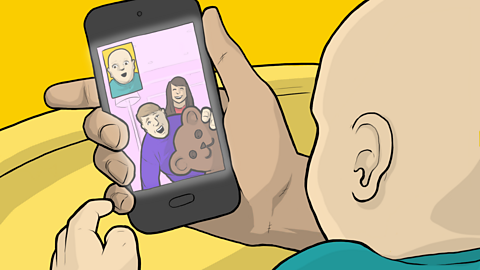
Pick a common household object and do a slow reveal of different parts of it on camera to amuse your little one on the call, says Janet. “Show a small amount of the item to the camera and see if they can guess what it is. Then maybe give them a clue and show them a bit more. Children think it’s hilarious when it finally appears on screen. It isn’t just about the prop, it’s about the voice you use, the build-up and anticipation.”
2. Charades
This classic party game is ideal for video calls and can be adapted to work for young children. Guess the animal is a good one and you can adjust the level of difficulty according to the age of your child, recommends Janet. Just act out the movements and noises the animal makes or for older children you could give clues about where it lives and what it eats. “If they’re under 2, you could use a prop and ask the children to guess from this clue.”
3. Photo challenge
“We send photos to family members of our kids doing silly things around the house using props and ask them to recreate the scenes,” says mum Nicola from Tiny Happy People’s online community. “The kids love seeing the grown-ups being silly and getting challenges back helps them to still 'play' with family who are far away.”
4. Family bake-off
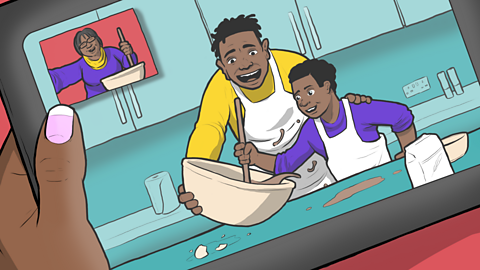
Elia, from THP’s online community recommends cooking together on a call. “We did it with the whole family and 10 children altogether. We all had the same list of ingredients for a chocolate cake, then each household added one special ingredient inside and one topper. My dad was head chef showing all the children how to make the cake, while us adults helped with the difficult stuff like the oven. It was nice because we were all on the call for three hours and it was really engaging.”
5. Bingo
Send homemade bingo cards to your loved ones with pictures instead of numbers for younger children and nominate a caller in your group (glitter bow tie optional).
6. Junk modelling
Send a list of recycling items ahead of the call and think of a theme, then once everyone’s online, challenge them to make something spectacular and talk about what they’re doing.
- Check out this video for inspiration for making toys from junk
7. Scavenger hunt
Come up with a simple list of things for your callers to find – first person back to the screen with all the items wins the round. “We love doing these hunts and it’s surprising how competitive the adults get too,” says Helen from THP’s online community.
8. Bedtime story
Ask what your grandchild’s favourite books are and see if you can pick up a second copy – maybe you can find it at your local library or pick one up online for a low price. Children love to hear the same story over and over, and they’ll love to hear a new person reading it to them. Read it aloud to them over video calls, making a special effort to do lots of voices and noises as this will really help them to engage – and don’t forget to point out the pictures. This is something Gillian from THP’s online community has tried out: “It’s actually really lovely. Especially when the grandparents do lots of rehearsals beforehand to perfect the characters.” Gillian has her own copy of the books at home to follow along with her little one closer up.

Engaging children in video calls
We asked grandparents to give us their screentime advice.
Shaun: "My three grandkids live in Manchester, me in Essex, so we rely on Skype to stay in touch. Usually we’ll just chat and catch up about anything and everything, but we’ve also started doing finger puppet shows – I sent some puppets to them so they can give it a go too."
My top tip: "Make sure you test your tech beforehand, so you don't waste time switching things on and off. That is a recipe for boring your grandkids! And most of all, don’t worry about feeling daft – and stick at it even if you feel uncomfortable at first."
It is strange talking to the screen, but once you see and hear your grandkids laughing and talking back it makes it all worthwhile.
Tracie: "My grandson lives fairly close to me, so I see him lots but I still find video calls are a great way to stay in touch: we especially enjoy storytelling and songs together. He loves it when l draw and create characters and make up a story around them. A particular favourite was when I drew fruit with faces on paper and glued them to my fingers. He loved my funny voices for each fruit!"
My top tip: "Record what you are doing each time you are interacting; you can build a library, which your grandkid can watch anytime."
Kids are easily amused, so you don’t have to do anything out of the ordinary to get them chuckling and chatting.