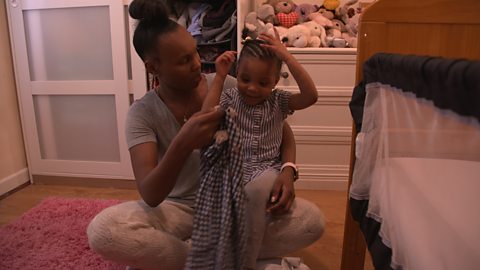
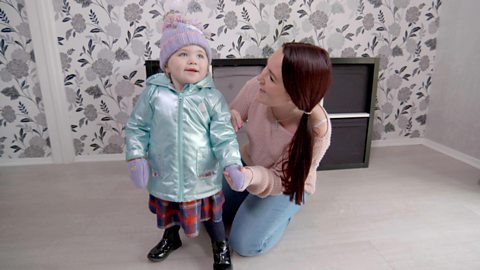
Getting shoes and coats on can be super frustrating for children, so it’s important to get some practice in so your they can do it nice and quickly on those busy school mornings.
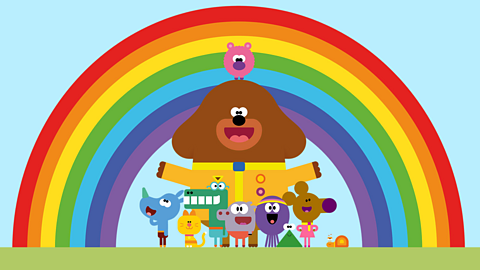
Watch the video below with your child as Duggee shows them how they can earn their getting ready badge before starting primary school.
Speaker 1: Ozzy, isn't it time for… Hey Duggee!
Group of children: Duggee!
Speaker 1: Duggee!
Children in classroom: Hey Duggee! Hey Duggee!
Speaker 1 Duggee and the getting ready badge.
Hello squirrels, I wonder what Duggee has planned for us today.
Duggee: A woof!
Speaker 1 Starting primary school? That's a big thing for a small person. It's exciting but there are so many new things to learn.
At school there are lots of grown-ups who will help us and tell us what to do. But sometimes we need to do things for ourselves and by ourselves.
Before you even get to school, it helps if we know how to get ready. Can you help, Duggee? Of course you can! because you've got your getting ready badge.
Well, almost ready.
So you don't forget your trousers like Duggee, It's a good idea to practice getting ready at home.
Ozzy here is showing us how he puts on his shoes and coat, even zipping up the zip all by himself. Looks tricky.
First, you make sure the zip go is right at the bottom.
Then he slots the two halves of the zip together, that's the difficult bit.
Then he holds the bottom in one hand, then zip. Pull in the other and the zip like a train on a track.
Well done Aussie. And here are some more experts getting ready to go home after another fun-filled today at school.
Didn't the squirrels do well today Duggee? Well done, squirrels.
You've earned your Getting Ready badge, just like Duggee.
Buttons and zips can be fiddly things, so don't worry if you can't do everything yet. Just keep practising, so that when you get to school, you'll be able to get ready all by yourself.
Well that was fun, wasn't it Duggee?
Duggee: Woof, woof, woof!
Speaker 1: Thanks for the reminder! Yes, you can watch more videos on the CBeebies's Learn app to help get you ready for school.
Bye bye everybody!
Tips for getting shoes and coats on
Make sure to spend plenty of time practising the tricky bits before school starts. Just let your child have a go every time they leave the house.
If they struggle with getting their coat on, there are a couple of tricks you could try.
You could try a 'coat flip' - place their coat on the floor with the inner part facing the ceiling and the collar or hood nearest their feet.
Get your child to pop both arms into the arm holes, then 'flip' the coat up and over their head. They can then shrug their coat into place.
Or you could use a chair to help them. Try placing the hood or collar over the back of the chair, with the inside of the coat facing towards them.
Get you child to sit in the seat and put their arms in one by one. They can then shrug the coat on.
If a coat zip gets stuck, try to pull it down and make sure it is completely secure at the bottom before trying again.
Your child might struggle with left and right shoes. A way to help with this is to cut a sticker in half and place the left half in the left shoe and the right half in the right shoe.
This gives them a visual way of telling which is which - what way round makes the full picture when you hold them up?
Getting your child to wiggle their toes and walk around is a great way to make sure shoes are on securely but not too tight.

How should you talk to your child about getting ready?
Getting ready is a great way for children to practise listening and following instructions.
Here are some tips on how to give instructions to your little one:
Use action words: say words like ‘zip’ and 'pull' to help your child understand instructions.
Talk through the process: describe what they are doing as they are doing it.
Repeat words: copy words that they say, and build them into sentences to help them stick.
Minimise distractions: at home. Reduce background noise, such as the TV or radio, so your child can focus on other people’s speech and expressions.
Play games: you can practise listening with your child at home by playing games such as 'Simon Says' that encourage them to listen and follow instructions.
Praise good habits: celebrate good attention skills from your child by praising behaviours like eye contact with positive reinforcement.
Calming frustrations
Sometimes when time is tight, it can be really stressful and frustrating if your child is struggling to follow instructions.
It’s ok to step in and help in those moments. Remember to take a deep breath, and that you can revisit the learning when you have more time.
Does your child love Hey Duggee? interactive
Play games and earn your Hey Duggee badges on the CBeebies website.