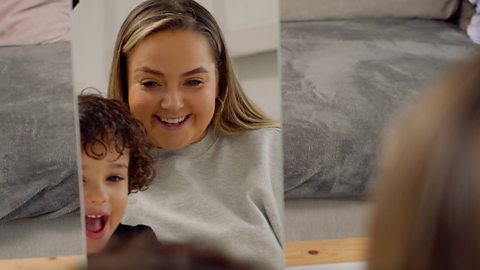
You might be tempted to try talking to babies and toddlers about lots of different things at once. After all, you might think that the more words they hear for different things, the more you'll build their vocabulary.
However, this may not be the case.
Professor Ben Ambridge puts the this theory to the test in the video below.
Ben
Well before they start talking for themselves, babies are learning words by listening to you. So how can you help them? Is it better to keep picking up new things and talking to your baby about them? Or should you look at what your baby's already interested in and talk to them about that? Should you lead or follow?
So how old is Reggie?
Grace
14 months nearly.
Reggie
Daddy!
Ben
Daddy, yeah. And do you notice him playing with lots of different things?
Grace
Yeah, he loves playing with any toys, ducks.
Reggie
Duck!
Ben
So we're going to try two different ways of interacting with Reggie as he plays with the toys. For this first test, what I'd like you to do is wait until Reggie's got hold of one toy, then pick up a different toy and start talking about that one.
Grace
What are you going to play with Mister?
Darren
Do you know what toy you gonna get? Oh, look at the train!
- What about this? Train goes choo choo!
Grace
Round the mat choo choo choo choo choo choo - choo choo choo choo.
Darren
Train is gonna make lots of stops on the way. It goes choo choo! It's gonna go…
Ben
So as you can see, it's quite hard to get Reggie to switch his attention. When he had the ball and you were trying to talk to him about the train, he just wasn't interested. This time, let's see what happens when you follow Reggie's lead and talk about whichever toy he picks. Have you got a ball?
Darren
- You're going to bring the ball to Daddy?
Grace
- Look at that ball! Oh yeah.
Darren
- Wow! Oh, thank you.
Grace
- Good boy.
Ben
So this time Reggie picked up the ball and you followed him on that and talked to him about the ball, and he was really listening to you nicely. Let's see what Reggie's learnt. Can you pick up the ball and ask Reggie, what's this? What's this Reg? What's this Reggie? Ah.
Grace
- Ball. Oh, wow. Is it a ball?
Darren
- It's a ball innit?
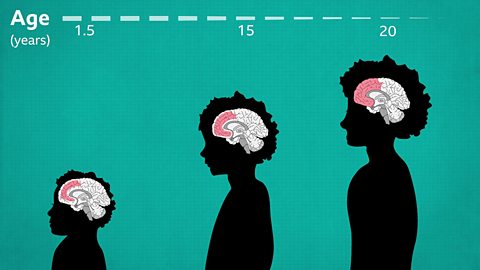
Neuroscience studies have shown that the part of the brain that's used to switch your attention from one thing to another, the prefrontal cortex doesn't fully form until you are around 20 years old. This is why young children find it very hard to switch their attention to different things. So by following your baby's lead and talking about the thing they're already paying attention to, you're really helping them to soak up as much information as possible. And in fact, researchers have found that children who share attention with an adult, learn words much more quickly and are likely to have a larger vocabulary when they're older. So following your baby's lead is a great way to help with their language development.
Try the leading and following experiment at home
Lay out a few toys for your toddler to play with.
Whichever toy they approach and pick up, wait until they're giving that toy their full attention, pick up another toy, name it, describe it and do whatever you can to get them to pay attention to that toy.
Take notice of how difficult it is to get your child to switch their attention.
The next time they're playing with a toy, instead of trying to get them to look at a different toy, talk to them all about the toy they're interested in. Notice how engaged they are - are they more animated? Are they saying more words or making more noises? Are they listening to you more?
Why should you follow your baby's lead?
The part of your brain that is used to switch your attention from one thing to another is called the prefrontal cortex. Studies have shown that this isn't usually fully formed until a person reaches around 20 years old.
That means that very young children find it very difficult to pay attention to more than one thing at a time.
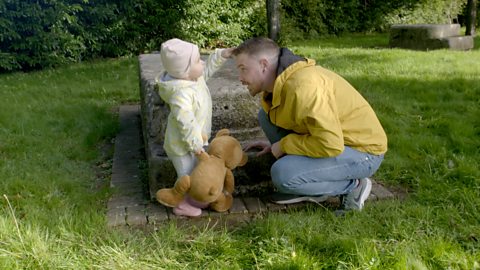
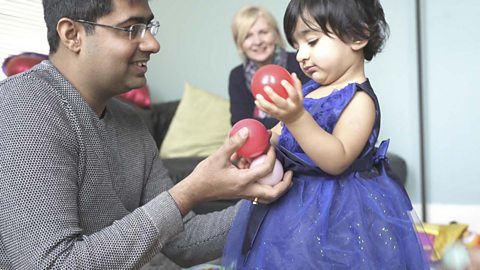
Given that, the best thing to do for toddlers' language learning is to let them lead - pay attention to the things they are most interested in or playing with already and speak to them about those things as they play. This way they'll absorb more information about what they're doing and the object they're interested in and will learn words more quickly.
This idea of both paying attention to the same thing is sometimes referred to as 'joint attention'..
How to build joint attention
There are lots of games and activities you can try with 12-18 month olds to help develop joint attention skills.
- You could go on a listening walk together, paying attention to all the sounds that catch their ears.
- You could give them a choice of items to explore while you're at the supermarket with your toddler
- You could have a go at following their lead during routines like bath time
- Try to spot when your toddler is pointing at things as this can make it easy to focus on what they're interested in