As children approach pre-school age, they'll often begin to build their understanding of the different sounds that make up words and be able to spot similarities and differences between different words.
You can put this to the test by playing some fun rhyming games.
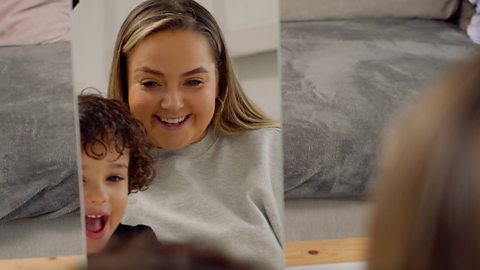
Dr Saloni Krishnan helps one family realise how much their child understands about word sounds in our Speech Lab - check out the video below.
Saloni
Children love learning new words and their brains are constantly thinking about them. Which words sound similar? Which words sound different? Knowing that fun sounds like bun is a skill called phonological awareness. But why is it important for language development? And how can rhyming help your child learn about the connections between words? Let's find out.
How old are you Ethan?
Ethan
- Four!
Saloni
And do you like rhyming?
Erica
He loves - yeah, he loves rhyming.
Ethan
- Yes. And singing and games.
Saloni
Wow, that's really great.
Shall we put that to the test then? I've got a special set of cards to show you, and I'd love if you could help me out. What do you think? You ready? Brilliant! On this set of cards, there are four animals. Can you tell you what they are? Ready?
Ethan
Rat.
Saloni
- Very good.
Ethan
Bat. Fox.
Saloni
- Fox.
Ethan
Cat.
Saloni
And can you tell me if one of these cards is different from the rest? Rat, bat, fox, cat.
Ethan
- Yeah.
Saloni
- Which one sounds different?
Ethan
- Fox.
Saloni
- Yeah. Very very good. Okay, I'm going to show you a few more cards this time. See if you can name these.
Ethan
Hat. Car. Pig.
Saloni
What's that?
Ethan
Box.
Saloni
- Mm-hmm. And, what do you think? Can you tell me if one of these cards sounds different?
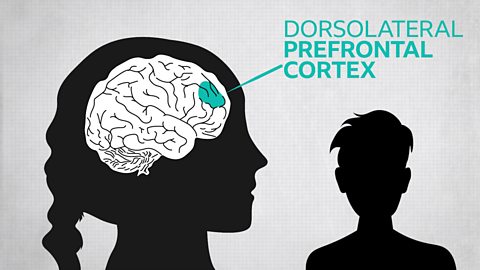
Okay, this time, Ethan hasn't spotted an odd one out, and that's because none of the words rhyme. That shows that he was hearing a really similar pattern of sounds within the rhyming words, and he understands how they're all connected together. Scientists have found that children between four and five use an area of the brain called the dorsolateral prefrontal cortex when they hear rhyming words. This helps them remember similar sounds or phonemes in words like the ee sound in tree and bee. Studies show that this phonological awareness is a really important step for reading. And as your child remembers and practises the sounds within words, it'll become easier for them to link those sounds to letters on the page. So, playing with rhyming words and sounding them out is a great way to help your little one recognise the sounds and patterns in words. And all of this will be really helpful when they start learning to read.
Try out this rhyming experiment at home
Try making a few flash cards for your child with animals with names that rhyme on them - e.g. Cat, Bat, Rat - and others that don't - e.g. Fox, Cow, Pig.
Present them with a group of these in turn, reading them out loud as you show them the cards.
First, present them with 4 cards, 3 with rhyming names and 1 that doesn't rhyme - Cat, Rat, Fox, Bat, for example. Ask them 'which one sounds different?'. Can they name the right card?
Next, present them with 4 cards where none of the animals' names rhyme - Cat, Fox, Pig, Hamster, perhaps. Ask them, 'does one of these sound different?'. Do they have an answer this time? Or are they unsure?
If they're able to answer the first question, it shows they're looking out for similarities and differences in the sounds that make up words.
What's going on in your child's brain when they understand rhyme?
Scientists have found that children aged between four and five often use an area of the brain called the dorsolateral prefrontal cortex when they hear rhyming words. This part of the brain helps them remember similar sounds in words like the 'ee' sound in 'tree' and 'bee'.
This means that playing with rhyming words and sounding them out can be a great way to help your little one recognise the sounds and patterns in words, a key skill that they will need when it comes to learning to read.
Building phonological awareness
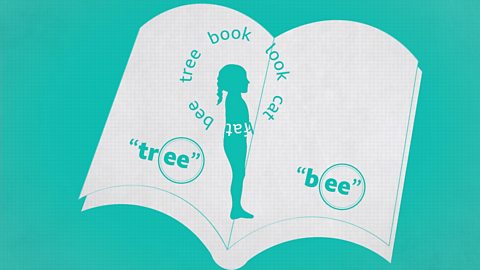
Awareness of the individual sounds that make up words is sometimes referred to as 'phonological awareness'. This is a great thing to have when children start school.
There are lots of games you can play to help your child build phonological awareness.
1. Sound sorting box
Children can learn all about the sounds that start words by playing the 'sound sorting box' game. All you need is some household items and a box to put them in.
2. Hopscotch
Hopscotch can easily be turned into a game for learning about letter sounds. Try drawing letters instead of numbers in the hopscotch grid and then when their stone lands on a letter, get them to think of a word starting with that sound by the time they skip over to it.
3. Sound treasure hunt
A sound treasure hunt is another fun way for children to practise word sounds. Can they find an object that starts with a 'c' sound? How about a 'b' sound? This game can be played at home or out and about in places like the supermarket.
4. I Spy
I Spy is a classic game for teaching about words that start with certain sounds. But you could even give it a twist and 'spy' objects that rhyme with other words!