By 18 months, your toddler might be starting to say a lot of single words - often naming things that they see, hear and touch.
But what's the best way to respond to them? Can you help them to build their skills more quickly through the way you respond?
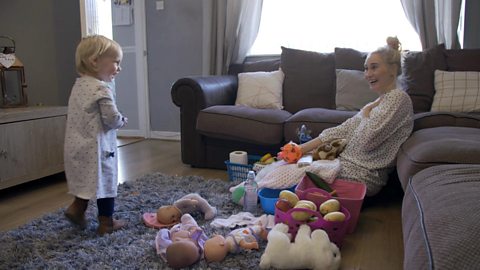
Dr Saloni Krishnan put it to the test in our speech lab, with the help of mum Melissa and her son Zane.
Check out the results of her experiment below.
Saloni
Cat…book…table… You might notice that your toddler is naming things as they begin to link words to objects. By listening to you, they're learning lots about language. But can the way you respond to them, actually affect their language development? To find out, we're going to investigate what happens when you talk to your toddler using a technique called expansion.
How old is Zane?
Zane
- Mum!
Melissa
He is 23 months old.
Saloni
And is he starting to say a few words?
Melissa
He's saying quite a lot of words now.
Saloni
He's a little sponge at this age, he's constantly listening and learning so much from the words you use around him. So expansion is a technique where you listen to what Zane is saying and you add words to make simple sentences. And to see if this technique works, what we're going to do is compare how many words Zane is hearing when you don't expand and compare that to how many words he hears when you do expand. Can you just pull one toy out of the bag each time and ask Zane what it is? Every time Zane replies, I want you to respond very simply.
Melissa
Zane, what's this?
Zane
Dog!
Melissa
- Yeah, dog, yeah. What's this?
Zane
- Ball.
Melissa
Yes, well done.
Saloni
In this first test, we didn't give Zane many more new words because we didn't expand what he said. In fact, he only hears 14 words from mum, in a one minute period. This time we're going to expand on Zane's language, I'd like you to pick one toy and ask him about this toy. Feel free to make simple sentences and give him lots and lots of input.
Melissa
Wow. I nearly caught it. Can you catch the ball? Can you throw the ball? Yeah. Thank you.
Zane
Ball!
Melissa
- Yeah, ball, yeah. We do lots of things with balls. You play basketball with balls don't you? And you bounce it this way or you play football with balls and you can kick the balls.
Saloni
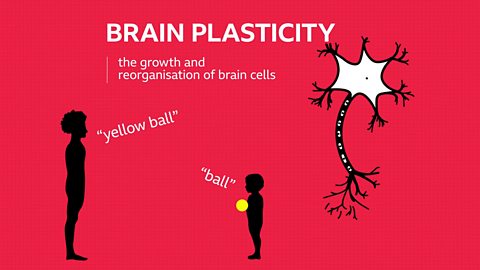
There was some great chat in that second test, using lots of words that give more information about the toy. This time, when Mellissa added Zane's single words into slightly longer simple sentences, he heard one hundred and fourteen words in one minute. Your toddler's brain is constantly changing as its tiny cells or neurones make new connections and get rid of old ones as they learn new things. This is what scientists call brain plasticity. So when you repeat and expand your child's words, their brain is working out
Try the best response experiment at home
Want to test out ways of responding to your toddler in real time? Our speech lab experiment is a simple way of seeing how responding in certain ways with your toddler can lead to them talking and interacting with you in different ways.
Firstly, try setting up a simple game of 'What's in the bag?'. Place a few items in a bag or pillow case, place your hand in, shuffle them around and pick one out. When you do, ask your child what the item is. When they respond, react to them very simply with a 'well done' or 'Yes, a hairbrush'.
Take notice of how many words they're saying as you play.
Now set up another game with some different objects. Again, pull one item at a time from the bag, and ask your toddler what it is. This time when they respond, add lots of simple sentences and phrases to the words they use. So for example, if they say 'ball', you could say back 'yes a ball, you play football with a ball' or 'it's a shiny ball'.
Again, take notice of how many words they're saying in response. Do you see an increase?
What's going on in my toddler's brain when we expand on language?
Your toddler's brain is constantly changing as its tiny cells or neurones make new connections and get rid of old ones as they learn new things. This is what scientists call brain plasticity. So when you repeat back a word a child has said and expand upon it to create a phrase or sentence, their brain begins to build new connections between different words and what they mean.
These are known as semantic links. Your child forms thousands of these links as they learn language.
The more they build these links and hear you saying longer phrases, the more likely they will be to begin using longer phrases themselves.
Find out more about expanding language
- Watch our Tools for Talking film where we explain more about why you should respond to toddler's early words by expanding on them.
- Check out a speech and language therapist's tips for building language learning into your everyday routines together.