Your baby is a little explorer soaking up all the sights, sounds and smells as they tune into the world around them.
But what do babies want and need from you? Do they want you to pay attention to them? Or do they want you to look at the thing that they're interested in with them?
We asked Professor Ben Ambridge to put this to the test in our Speech Lab and see what the results were.
Watch the full experiment in the video below to find out what the big deal is with shared attention.
Ben
Your baby is a little explorer soaking up all the sights, sounds and smells as they tune into the world around them. So what do babies want here? Do they want you to pay attention to them? Or do they want you to look at the thing that they're interested in with them? Let's find out.
So how old is Benji?
Sonia
Benji's ten months.
Ben
And have you noticed him trying to get your attention or like making noises or moving about if he sees something interesting?
Sonia
Well when he gets excited he tends to wave his hands quite a lot and he clenches his fists together.
Ben
So when he's looking at you and trying to get that attention there's basically two different ways that you can react. So what we're going to do today is see which one he seems to prefer. So we're gonna see what happens when mum pays attention to Benji but doesn't share attention to the puppets.
Sonia
Benji! What are you looking at Benjamin?
Ben
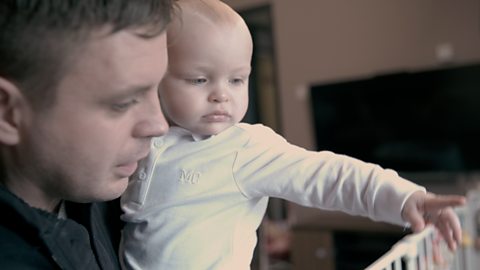
So what we're seeing here is Benji making an open-handed pointed gesture towards the puppet. So what he wants, is for mum to share attention to the puppet with him. So this time, you're going to share attention to the puppets with Benji. So when he looks look back and for that Benji and the puppets.
Sonia
Benji! [MAKES MONKEY NOISES] Is it a monkey? What is it? Look!
Ben
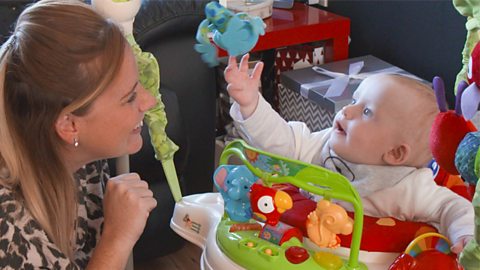
So now Benji's engaging much more. He's looking back and forth at you and the puppet and he seems much happier. So this triangular interaction between between you, Benji and the puppet is really important for language development. Scientists have found that when you and your baby interact with something together your brain waves can actually synchronise. That means that the brain's electrical pulses begin to match up as you look at the same thing. And because your baby knows you're looking at something with them they'll naturally link your words to the thing that you're both looking at. There are plenty of great opportunities to share attention with your baby during everyday things like getting dressed or bath time. So keep engaging and responding to whatever takes their interest, and you'll really be helping to boost their language development.
Try the joint attention experiment at home
When your baby has noticed something and wants to show you, there are two different ways that you can react.
By trying this experiment at home, you'll be able to work out which one your baby prefers and which is better for their language learning.
In our experiment, we use a puppet to get baby's attention, but you can use any object around your house. You want the baby to notice the object, look at it and try to engage with it.
First, see how your baby reacts when you pay attention to them but don't share attention with the object. So don't look at the object or point to it.
How does your baby react? Do they point at the object? Or do they seem confused?
Compare their reaction to what happens when you share attention to the object. This means sharing your attention between your baby and the object and looking at both objects throughout the conversation.
In our experiment, when our family shared attention with the object, baby was a lot happier and engaged with the conversation. Is your child the same?
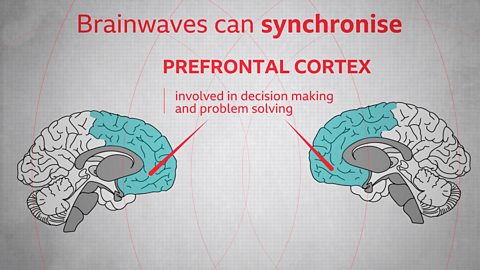
What happens in your baby's brain during joint attention?
The triangular interaction created when you and your baby engage with another object is really important for language development.
Scientists have found that when you and your baby interact with something together, your brain waves can actually synchronise.
That means that the brain's electrical pulses begin to match up as you look at the same thing.
The researchers found that social signals like eye contact and gestures increased the likelihood of this happening.
When these brain waves synchronise, your baby is more likely to link your words to the object that you're both looking at. And this is why shared attention is so important for language learning.
How to encourage joint attention
There are many ways you can help your baby develop joint attention skills. We've listed a couple below:
- Bubble blowing is a great activity for working on joint attention and communication skill development.
- Practice joint attention as part of your daily routine, during tasks such as brushing teeth or at bath and mealtimes.
- Playing hide the toy helps teach your child to follow your gaze, point and head turns.