Home > Activities > 4-5 years
Spending some time looking after an animal comes with many advantages for your child’s language and wellbeing.
At around 4 years old, children are getting ready to start school. The responsibility and emotional development that comes from caring for a pet can really help them prepare for this big step.
Whether it's your family pet or one that belongs to a friend or relative, why not take some time together to chat to your child about how to look after it?
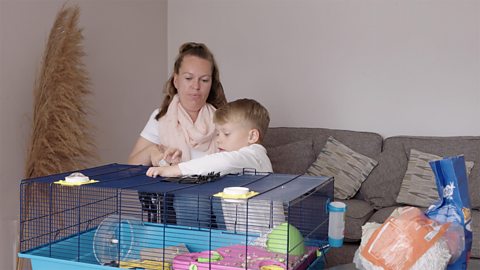
Check out the video below to see how caring for a hamster can become a great learning opportunity.
Oh, look! She's come to say hello.
She's like cleaning herself.
Is she? That's nice. That means she's happy, doesn't it? What do we need to do to get?
Hay
Hay ready for the day?
She needs food!
She needs food, doesn't she?
I'll go and get some.
Yeah? You're going to get it? Good boy.
Here's her food!
That's it! Come down carefully. And then can you get the bedding as well, so we can do her bedding? Well done, Ro! Good boy. We need to put some in that bowl. You want to put some in the back one as well? She's a hungry hamster, isn't she? What else do we need to do once we've given her food?
Bedding.
Bedding. Just a little bit, remember. Good boy. What does she need when she's thirsty?
Water.
Water, yeah. Stand on your step stall.
It's cold.
Yeah, that's good. That's what she wants.
I'm trying my best. I know, you're doing very good.
How do you do this?
So turn it so the silver bit goes through the bars. Other way round…There you go! You've done that, well done. What's she got in her cheek?
Food.
Yeah, so what do hamsters do? Do you remember?
They put it in their cheek.
Can you show me? Do they put it in their mouth? And where does she take it?
Into there.
Yeah. Nice and gentle. We have to make sure we lock it properly, don't we? Because what happens if we don't lock it?
Her escape.
Shall we say bye-bye to her?
Bye Hay-Hay.
Well done Rowan.
What are the benefits of letting your child look after a pet?
- Caring for a pet teaches children to be kind, develop empathy and to start to understand the feelings of others. This is an important skill in early interaction.
- It also has the added benefit of supporting speech and language through following instructions and challenging their concentration skills.
- Giving your child more complex instructions helps them practise positioning words such as “in” and “on top of”.
- Chatting to their pet (in the form of praise, orders and encouragement) gives children more opportunities to form sentences.
- Anticipating an animal's needs makes them think beyond the here and now.
- Taking on this responsibility builds self-confidence and teaches children about being compassionate.
More on why bonding with pets is good for children's learning and wellbeing
How can children help look after pets?
There are loads of ways to get your child involved in pet care, with your supervision. Here are a couple of things you can encourage them to take part in, which are also great opportunities for chat and language development:
- Feeding pets
- Playing games with pets
- Taking dogs out for walks
- Grooming
- Training
- Visiting the vet
Talk to your child about when an animal might need feeding, how much they need to eat and where you keep their food.
Encourage them to look out for when the water bowl or dispenser is empty and chat them through process as you change it.
The more you do it, the more involved your child can be and eventually they'll be able to do it themselves.
Make sure to give them lots of praise as you go, to help build their confidence and encourage them think about others more regularly.
More activities to encourage emotional development
- As well as thinking about how pets might be feeling, children can also learn about human emotions with the face game.
- If you don't have any pets, why not try holding a teddy bear's picnic? It's a great way to teach empathy and encourage sharing.
- Your child's wellbeing is extremely important. Check out these 8 activities to help boost your child's mental health.