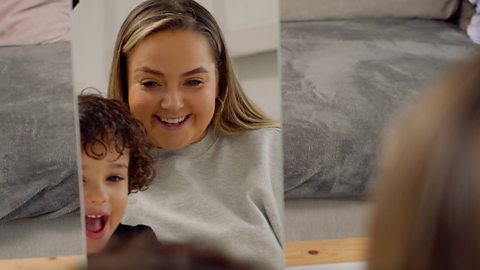
Early on, you might start to see your child developing their own voice, thoughts, and feelings, which can be exciting.
So what's the best way to support this as a parent and encourage them to learn and grow?
Here are our top tips for supporting your child’s curiosity and independence in a fun and engaging way…
Parent talking with child:
Oh that is a carrot! which animal likes to eat carrots? bonnie! bonnie is? eat bonnie! like my mother bonnie! do you think a dinosaur will want to eat? or what do you think a dinosaur will eat? I think a dinosaur will eat a pumpkin. I'm not in the right position. What does he like? Carrots. That's a good idea.
What's outside? What's outside? Can you tell me what you can see outside? What's your favourite thing that you can see? Birds! Birds! There's one over there. Count that one, hand that one over there. Peas? Yes, and that one? Four. Four? Can you say four?
Did you go to the zoo yeah and what did you see at the zoo which animals did you see DINOSAUR!
Which is your favourite dinosaur? DINOSAUR! Good job! Well done!
Let your child know they're heard
You know that you’re listening to your child, but it’s important to make sure your child knows it too.
Repeating what they say to you back to them helps you connect and also helps words stick in their heads.
This can a great way to help them learn words they can use to label their feelings with in the future - like 'happy' or 'sad'.
Talk about what's going on
Children are constantly learning and taking in new things around them, and they will have plenty of thoughts about what they are seeing.
It can be great to relate your chats to everyday events – like going to the park, out to the shops, or even just seeing family.
This can be a great opportunity to have fun and engage with your child’s personality – so remember to be really expressive and respond to what they tell you.
Joint attention
Listening to your child's thoughts about the world can a lot of fun, but it's also a great opportunity for socialising and learning.
Engaging with what your child is doing or looking at is called joint attention, and it can help them feel connected with you, as well as boost their language learning.
Trying different activities like copying each other, using a sing song voice, and repeating words can be a great way to show your baby that you are listening and engaged.
You can try different methods and see which your child prefers – every child is different.