The leaves are changing, autumn is here, and it’s time to get spooky!
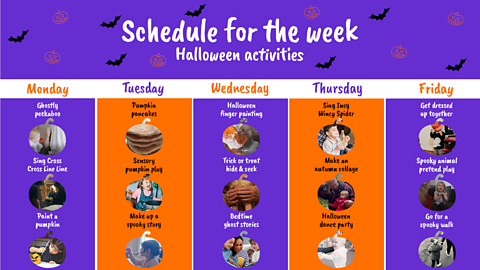
Halloween can be full of new sights and sensations for your little ones and is also a fantastic opportunity to practise vocabulary and encourage learning through play. Why not make a little at-home Halloween party for your child, complete with fun and games?
Specialist speech and language therapist Alys Mathers has conjured up some spooktacular Halloween activities to get you started.

Get gutsy with spooky sensory play
Rather than carving a pumpkin, why not light up your little ones’ smiles by getting together to paint one?
You can use fingers or tools to decorate, or even cut pumpkin pieces into shapes for your child to stamp and identify. These don’t have to be complicated – crescent moons, clouds and stars are still on-brand for a dark and stormy night.
Using colours associated with Halloween such as black, orange, green and purple might also present a good naming challenge for younger children.
Take it further and create a scary texture playground: fill bowls with pumpkin insides, peeled and chopped up grapes and spaghetti worms and let your little ones explore.
“Getting children used to feeling different textures and talking about together expands your child’s vocabulary,” says Alys.
Remember that expressing disgust is just as important as expressing delight.
Encourage sounds like ‘ooh!’ and ‘yuck!’ so your child can share when they like or dislike a texture.

Models and mummies
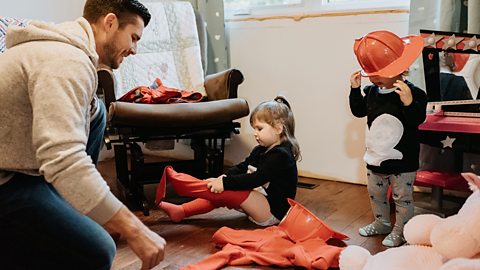
Halloween wouldn’t be Halloween without fancy dress! Putting a costume together can also be a great way to introduce some new vocabulary.
“Dressing up is a good opportunity to talk about names of clothing and practice some descriptive words,” says Alys.
Raid the wardrobe and encourage them to pick out an outfit – and don’t forget to model language as well as your clothes. Give your child lots of examples of descriptive words in full sentences to show them how the words are used.
For example, you could say: “I want the sparkly top,” or “I like this long scarf”. You can even make it seasonal by adding: “This is the same colour as the pumpkin, isn’t it?”
Similarly, you can use toilet paper to get wrapped up in the fun. Alys says making your child into a mummy is a great way to identify body parts:
“Ask them to tell you where to wrap them up next, ‘Put it on my leg’, ‘arm’, and so on, and they’ll be practising the names of body parts at the same time.”
You can encourage them to take charge by asking: “Where are you going to wrap next?” or “Shall we do the other leg now?”
Treat… or treat
For very young children, giving out treats is a chance to practice saying or indicating they want ‘more’ – an important skill.
Alys suggests making it into a game: give them a little bit of a treat, then when they reach for some more, say, “Do you want more, or finished?”
“Encourage them to say they want more, or ask for the thing, before you give it,” she says. “They need the opportunity and expectation to ask with words – or signs – in order to use them.”
For bigger children, putting a twist on trick or treat is something you can do at home.
Hide little ‘treats’ around the house – either sweets, healthy snacks they love or spooky ornaments and toys – then give your child instructions for where to find them, such as “Look under the kitchen table,” or “Open the cupboard by the door”.
This will help them with listening and following instructions in a fun way.
In the dark, dark, hour…
What better way to end a day of Halloween fun than a bedtime ghost story?
When you read to your child, put them in charge of making the sound effects. For example, you could give them a shaker to shake whenever you say the word ‘skeleton’, or ask them to make a ‘wooo’ noise whenever you say the word ‘ghost’.
“You can give older children a few different noisemakers to make more sound effects,” says Alys. “This helps develop their listening skills.”

In case you missed it
Download our interactive weekly schedules
Browse our interactive activity schedules, challenges and checklists. All of our PDFs are interactive, which means that you can click on any activity and find out more.