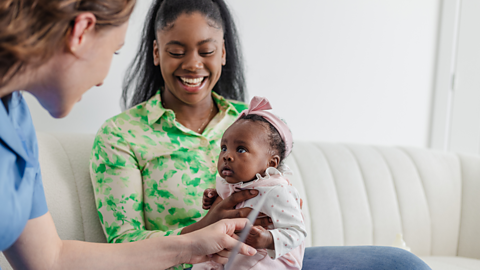
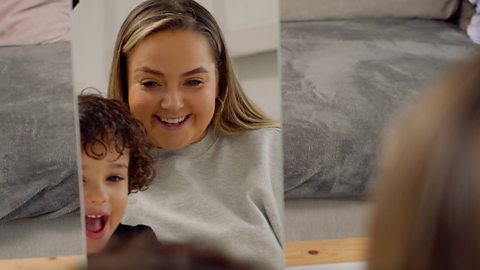
Singing regularly to babies, whether you can carry a tune or not, can be a very important part of their development.
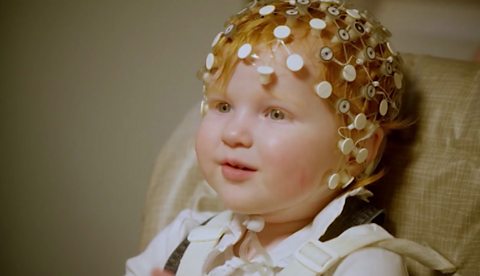
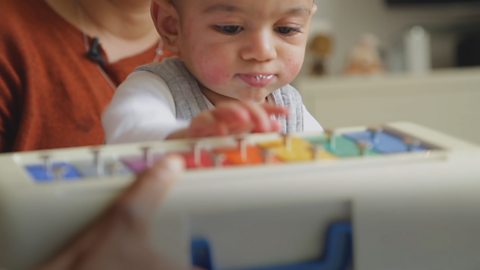
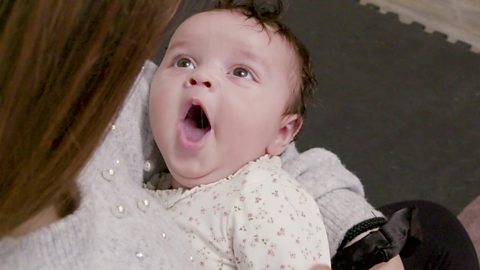
In our quick video below, child language researcher Dr Michelle Peter explores with parents what happens when they sing fun songs and nursery rhymes to their babies.
Why not try it at home with your baby? How will they react?
Michelle:
They like the rhythm, they like the tune, but, again, it's just exposing that extra language to them.
Three little ducks went swimming one day,
Across the pond and far away,
Mother duck said "quack, quack, quack, quack",
But only two little ducks came back.
Now it's your turn.
Now it's your turn!
They like songs that are repetitive and they can predict what's going to come next.
Dad:
Like 'wheels on the bus'?
Michelle:
Yeah, exactly, ones they can join in with.
A, B, C, D, E, F, G,H, I, J, K, L, M, N, O, P.
Mum:
And what age would you say that they recognise the songs? I sing 'If You're Happy and You Know It, Clap Your Hands' and she looks like she understands, but I'm not sure that she does.
Michelle:
It's really hard to pinpoint. But that's really nice; singing lots can be really helpful.
And it's not that it's the singing, per se, it's the interaction between you both that is really beneficial.
Now I know my A B C, next time won't you sing with me? Yay!
Why is singing to babies important?
Singing to your baby is one of the first language lessons you can give them. Even before they're born, babies recognise simple music and their mother's voice whilst in the womb.
Music and child brain development are closely linked, so the more your child is involved in singing the better it is for their development.
It's also great for language development from a very young age. When you sing, even little babies pick up on intonation or the patterns of talking, which is why you might find them babbling with different tones – they might sound like they’re talking before they actually are.
Want to find out 6 more things you didn’t know about your baby and music?
5 singing activities to boost your baby's development
- Make noise with household objects
- You can dance with children of any age, from newborns to preschoolers
- Make a simple shaker or other DIY instruments
- For older children, try changing the words of nursery rhymes
- Sing through doing the chores
Nursery rhymes are one of the simplest ways to introduce music to your child at an early age. Want to find out more? Have a look at these 7 benefits of nursery rhymes for babies and toddlers.
Or if you're struggling to pick a rhyme to sing, try out nursery rhyme selector, which will choose for you!
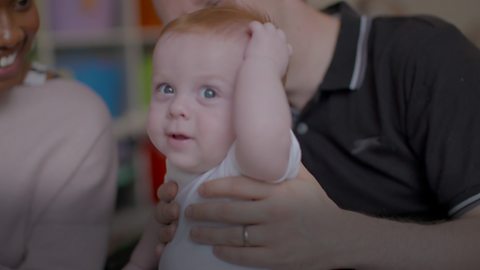
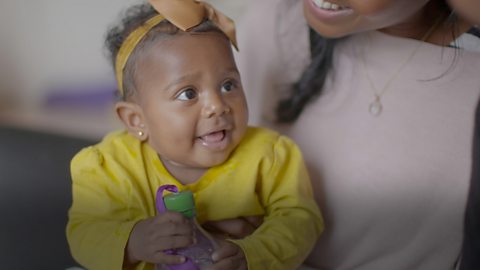
Image caption, Singing and clapping can help build your child's sense of rhythm and language skills.
1 of 3