This lesson will give you a broad understanding of the term ‘fake news’ and the skills and techniques to distinguish between what’s false or fake and what’s real.
Learning outcomes
At the end of the lesson students will think more critically about what they see and hear online and on social media, and consider the source of this information and whether they believe it or share it.
Brief overview
The term 'fake news' has become commonplace. This lesson helps young people to think about how it applies to them and their lives.
The vast majority are using smartphones, tablets and laptops to access material across the web - some of which will be true, but some will be inaccurate, false and even fake.
Again, most students use social media, often having accounts long before the recommended age of 13 (Children’s Online Privacy Protection Act).
This lesson guides them through various types of false and fake news and explains:
- The BBC’s definition of false information distributed deliberately, usually for political or commercial purposes
Lesson 1: Real news versus fake news slideshow. document
Click here to download PowerPoint (PPTX)

Preparation
- Students require pens and paper
- Download the prepared slideshow
- Watch the film Recognising Fake News, as suggested in the slideshow
- Watch the film Checking the Story, as suggested in the slideshow
- There’s a choice between Exercise 1 and Exercise 2 - the latter requires students to access computers
- For Exercise 3, download character briefs and separate one per student (six altogether)
- Download the helpsheet for students, if required
Helpsheet. document
Click here to download PDF

There are two videos
Video 1 explores the different types of fake news.
Video 2 helps young people to check if something is real.
Exercises
Exercises 1 and 2 look at how easy it is to make fake news or re-tell the same story in different ways.
Exercise 1 is low-tech while Exercise 2 is computer-based. You can use one or the other
Exercise 3 asks young people to use their journalism skills to detect what’s real, what’s fake and who to believe
Exercise 1: Proving story is real. document
Click here to download PDF

Exercise 2: Same but different. document
Click here to download PDF

Exercise 3: What's true? document
Click here to download PDF


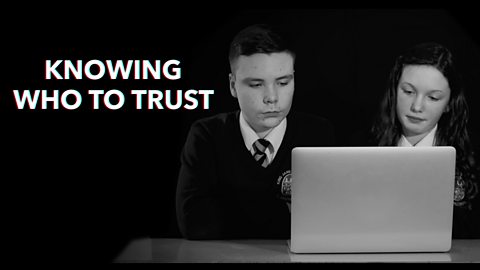
Knowing who to trust. video
In this video you'll hear from Amol Rajan, the BBC’s media editor, journalist Mukul Devichand and Rachel Schraer from BBC Reality Check.
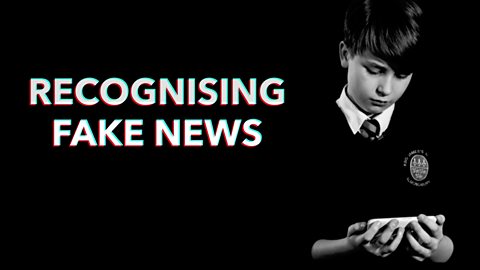
Recognising fake news. video
In this video you'll hear from Amol Rajan, the BBC’s media editor, and journalists Natalie Miller, Mukul Devichand and Rachel Schraer from BBC Reality Check.
Checking the story. video
In this video you will hear from BBC journalists Natalie Miller, Alex Murray and Rachel Schraer from BBC Reality Check.
Numbers and the tricks they play. video
When you’re looking at news stories remember that it’s not just the words you need to take notice of but the numbers too.

Lesson 2: Sources and who to trust. video
This lesson plan will give you an understanding of the importance and use of sources and ways to identify which ones are reliable and trustworthy and why it’s recommended to use more than one.
Lesson 3: Social media, images and data. video
This lesson will demonstrate how to spot whether a social media feed is genuine or fake, to consider the manipulation of images and think carefully about how the addition of numbers to a story may not be a clear as it first seems.